
What's Happening?
Russian scientists are testing a new plasma propulsion system that could significantly reduce travel time to Mars. Developed by Rosatom's Troitsk Institute, the engine is currently undergoing ground-based trials and could be ready for space missions by 2030.
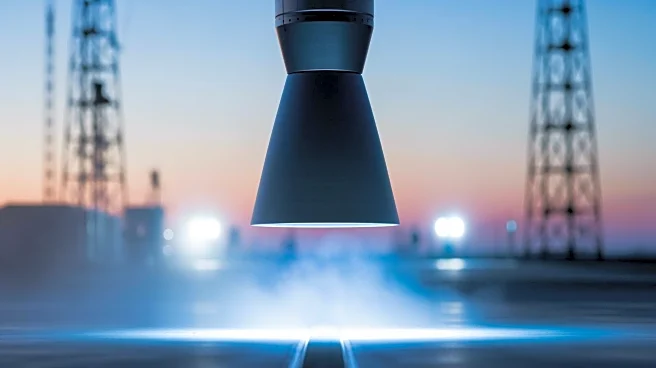
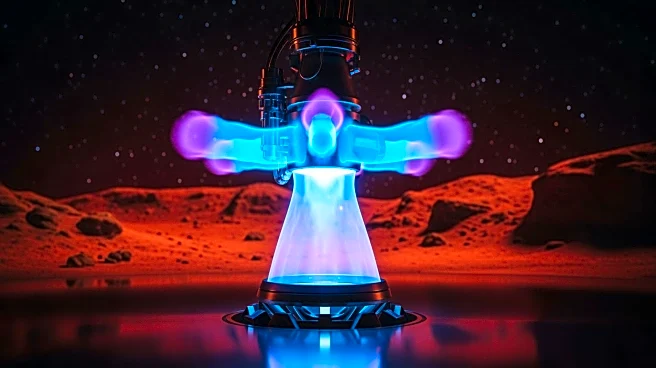
The propulsion system uses electromagnetic fields to accelerate hydrogen particles, achieving speeds up to 100 kilometers per second, far surpassing the capabilities of current chemical rockets. This technology could revolutionize interplanetary travel by shortening mission durations and reducing fuel mass. The engine operates in a pulse-periodic mode and has demonstrated a service life of 2,400 hours, sufficient for a complete Mars mission. It relies on hydrogen fuel and an onboard nuclear reactor for sustained power, offering a more efficient alternative to conventional chemical propulsion.
Why It's Important?
The development of this plasma engine represents a significant advancement in space exploration technology. By potentially reducing the time required for missions to Mars from months to just 30 days, it could accelerate human exploration of the planet. This innovation may also influence global space exploration strategies, as countries and private companies like SpaceX aim to establish a human presence on Mars. The engine's ability to function as a space tug for transferring cargo between planetary orbits could enhance logistical capabilities in space. Additionally, the use of hydrogen fuel, which is abundant in the universe, opens possibilities for in-situ refueling, further extending mission capabilities.
What's Next?
The plasma engine is expected to be space-ready by 2030, contingent on successful testing and funding. Its deployment will require overcoming regulatory challenges, particularly concerning the use of nuclear power in space. International space agencies and watchdogs will need to approve the handling of nuclear materials during launch. The integration of this propulsion system into crewed spacecraft will also necessitate significant redesigns to address thermal management, radiation shielding, and power distribution. As testing continues, the global space community will closely monitor the engine's performance and potential applications.