







What's Happening?
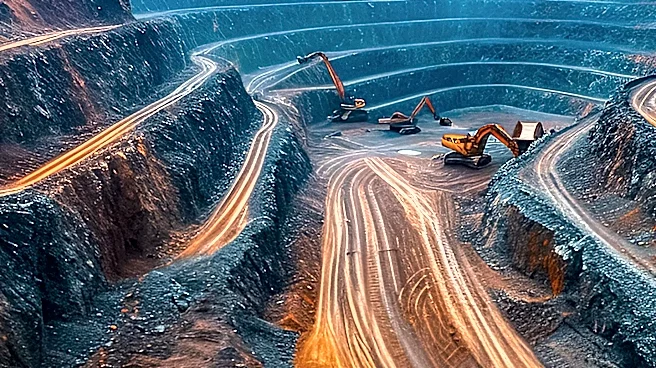
The International Energy Agency (IEA) has identified significant supply risks in France's critical minerals sector, which are crucial for the country's energy transition. The IEA's 2026 Global Critical Minerals Outlook highlights the lack of downstream
processing infrastructure in France, which poses a strategic vulnerability. The report emphasizes that while France has geological potential, it lacks the facilities to process raw materials into usable industrial products. This issue is compounded by geopolitical uncertainties and export restrictions, particularly from China, which dominate the refining of essential minerals like lithium and rare earth elements. The IEA warns that these supply chain constraints could hinder France's ambitious energy transition goals, which rely heavily on processed mineral inputs for technologies such as electric vehicles and renewable energy systems.
Why It's Important?
The findings underscore a critical challenge for France and other Western economies in securing the necessary materials for their energy transitions. The concentration of refining capacity in countries like China and Indonesia creates a dependency that could disrupt industrial production if geopolitical tensions escalate. The IEA estimates that up to $6.5 trillion in global industrial output could be at risk if supply chains are disrupted. This situation highlights the need for France to develop its processing capabilities and diversify its supply sources to mitigate these risks. The report also points to the broader implications for European industrial policy, as the continent seeks to reduce its reliance on external sources for critical minerals.
What's Next?
France is taking steps to address these vulnerabilities through its France 2030 Critical Minerals Framework, which includes a €500 million investment to enhance domestic extraction and processing capabilities. This strategy involves developing lithium recovery from geothermal brines in Alsace and expanding refining infrastructure. However, the IEA cautions that these efforts may not be sufficient to meet the growing demand for critical minerals by 2035. The report suggests that France and its European partners need to accelerate their strategic investments and policy responses to keep pace with the rapidly evolving risk environment.
Beyond the Headlines
The IEA's analysis also highlights the importance of workforce development in the critical minerals sector. France faces a shortage of skilled labor in mining engineering and mineral processing, which could further constrain its ability to develop domestic supply chains. Additionally, the report notes the potential for urban mining and recycling to play a role in reducing dependency on external sources, although this will require significant policy support and infrastructure development.