



What's Happening?
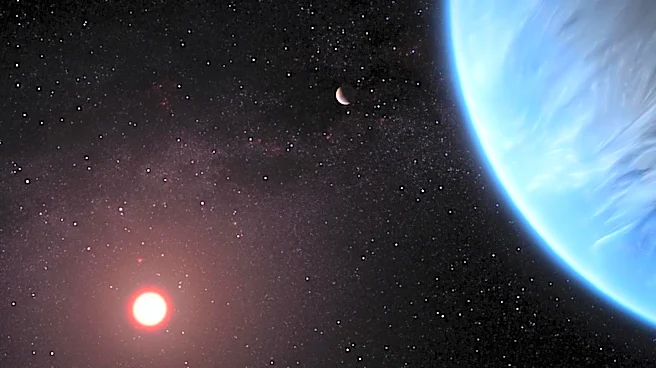
Astronomers have identified a new exoplanet, GJ 523b, which is 23.5 times the mass of Earth and 2.55 times its radius. Despite its significant mass, standard planet-formation models struggle to explain why it did not accumulate a substantial hydrogen-helium
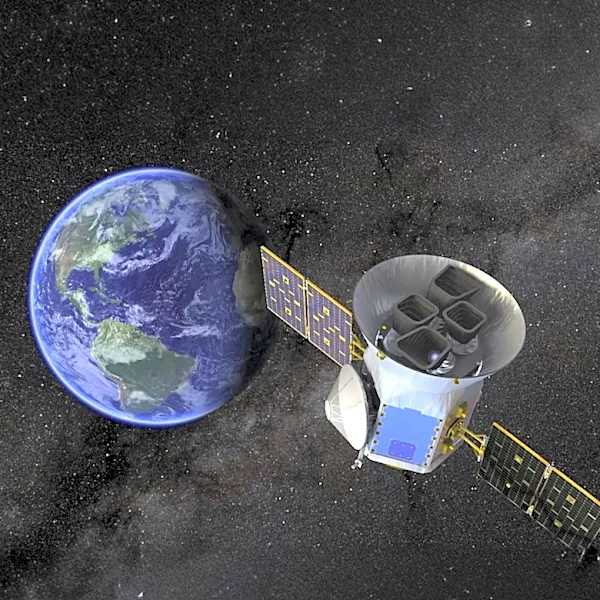
envelope. The planet is extraordinarily dense, with a bulk density of 7.8 grams per cubic centimeter, approximately 40 percent greater than Earth's, suggesting it is primarily composed of rock and metal with very little light gas. This discovery, detailed in a preprint submitted to The Astronomical Journal, indicates that GJ 523b possesses the dimensions of a sub-Neptune but the density of a much heavier, rocky world. The planet orbits a K dwarf star located about 87 light-years from Earth and is relatively young, estimated to be around 169 million years old. Its youth further deepens the mystery, as there has been insufficient time for a massive primordial atmosphere to dissipate through ordinary atmospheric escape. The discovery relied on data from NASA’s Transiting Exoplanet Survey Satellite (TESS) for its radius and the NEID spectrograph on the WIYN 3.5-meter telescope for its mass.
Why It's Important?
The discovery of GJ 523b is important because it challenges prevailing theories of planet formation, particularly the core-accretion model. This model suggests that planets of such immense mass should typically accumulate vast amounts of gas, forming gas giants. GJ 523b's dense, rocky composition at such a high mass indicates that current models may be incomplete or require significant revision to account for such outliers. The planet's unusual characteristics, including its near-polar orbit and young age, suggest that violent past events, such as giant impacts or gravitational scattering, or a unique growth mechanism that prevented efficient gas accretion, might be at play. Understanding how GJ 523b formed could lead to a more comprehensive understanding of planetary diversity and the conditions under which different types of planets can emerge. This research contributes to the broader field of exoplanetary science, pushing the boundaries of what is considered possible in planetary architecture and evolution.
What's Next?
Future research will focus on refining the measurements and exploring the various proposed formation scenarios for GJ 523b. More observations from the NEID spectrograph are planned to improve the accuracy of its mass determination and search for any longer-period companion planets that could have influenced its development. A Rossiter-McLaughlin observation will be crucial to precisely determine the planet's orbital geometry and confirm if it is indeed in a polar or even retrograde orbit. Additionally, atmospheric spectroscopy will be attempted to ascertain whether GJ 523b truly lacks hydrogen and helium or if it retains a compact atmosphere that current bulk density measurements cannot fully resolve. The University of Wisconsin–Madison announcement highlighted that the planet's unique combination of mass, density, youth, and orbital tilt makes it a 'curveball,' indicating that further observations are essential to unravel its mysterious origins and provide a more complete picture of its formation history.
Beyond the Headlines
The concept of a 'mega-Earth,' as proposed by the researchers, represents a new classification for planets that are too large to be typical rocky super-Earths and too dense to be ordinary sub-Neptunes. This classification highlights the increasing diversity of exoplanets being discovered and the limitations of existing categories. The existence of GJ 523b suggests that the processes governing planet formation are far more complex and varied than previously understood, potentially involving extreme events or conditions that are not yet fully integrated into theoretical models. This ongoing re-evaluation of planetary classifications and formation theories has profound implications for our understanding of the universe's potential for life, as the composition and atmospheric properties of planets are critical factors in habitability. The study of such extreme exoplanets pushes scientific inquiry into new frontiers, challenging astronomers to develop more sophisticated models and observational techniques to explain these cosmic anomalies.