







What's Happening?
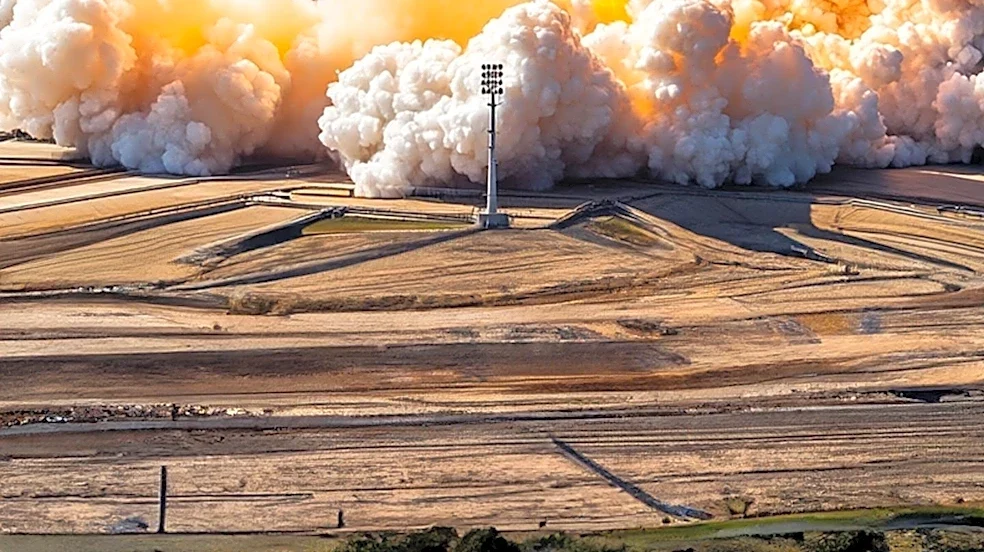
Lt. Gen. Philip Garrant, head of the Space Systems Command, stated that the U.S. Space Force requires a third spaceport capable of supporting medium and heavy launches by 2030. This goal is considered aspirational but crucial for enhancing the U.S. military's
launch infrastructure and ensuring resiliency. The Space Force currently operates ranges at Cape Canaveral Space Force Base, Fla., and Vandenberg Space Force Base, Calif., but these are projected to reach capacity as demand for government and commercial launches surges. Air Force Secretary Troy Meink previously indicated the need for an additional site due to limitations at existing facilities. The White House's updated National Space Transportation Policy in August predicted a fivefold increase in annual U.S. launches by 2030, reaching 1,000, and called for the Department of Defense to explore options for new spaceport infrastructure on federal property.
Why It's Important?
The call for a third launch range by 2030 underscores the escalating importance of space capabilities for U.S. national security and economic competitiveness. A new spaceport would provide critical redundancy and increased capacity, reducing bottlenecks and ensuring continued access to space for both military and commercial missions. This is particularly vital given concerns about the vulnerability of existing space assets, such as GPS, to interference. Expanding launch infrastructure supports the growing commercial space industry, fostering innovation and job creation. Furthermore, it enhances the U.S.'s ability to rapidly deploy satellites and other space assets, which is crucial for maintaining technological superiority and responding to evolving global threats. The investment in space infrastructure reflects a strategic commitment to securing the U.S.'s leadership in the space domain.
What's Next?
The Space Force has formed an operational planning team to evaluate the requirements for building a third spaceport, considering various options such as public-private partnerships, commercial land use, or new federal installations. This team will present its findings and suggestions to leadership at NASA, the National Reconnaissance Office, and the Space Force. In the interim, the Space Force is strengthening partnerships with commercial spaceports like the Mid-Atlantic Regional Spaceport and the Pacific Spaceport Complex. Significant investments are also being made to expand capacity at existing coastal spaceports, with Congress allocating $1.3 billion in 2024 for 'Spaceport of the Future' upgrades through 2028. The Space Force plans to request additional funding in fiscal 2028 to further enhance launch pads, support facilities, and infrastructure at current sites.
Beyond the Headlines
The push for a third U.S. launch range reflects a broader strategic shift towards a more resilient and robust space architecture. Beyond simply increasing launch capacity, this initiative addresses the critical need for diversification and redundancy in space access, mitigating risks associated with potential attacks or disruptions to existing sites. It also signals a recognition of space as a contested domain, where assured access is paramount for both military operations and economic stability. The collaboration between government agencies and the commercial sector in developing this infrastructure could set a precedent for future large-scale national projects, blending public investment with private innovation. This expansion could also lead to the decentralization of space launch capabilities, making the overall system more robust against localized threats and fostering regional economic development around new spaceport locations.