




What's Happening?
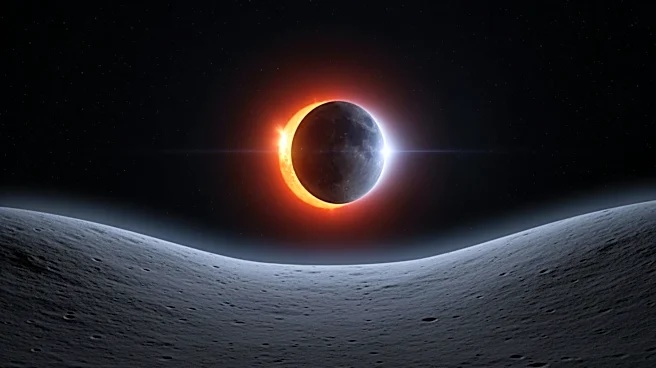
During the Artemis 2 mission, astronauts aboard NASA's Orion spacecraft experienced a rare solar eclipse from deep space. The crew, consisting of commander Reid Wiseman, pilot Victor Glover, and mission specialists Christina Koch and Jeremy Hansen, observed
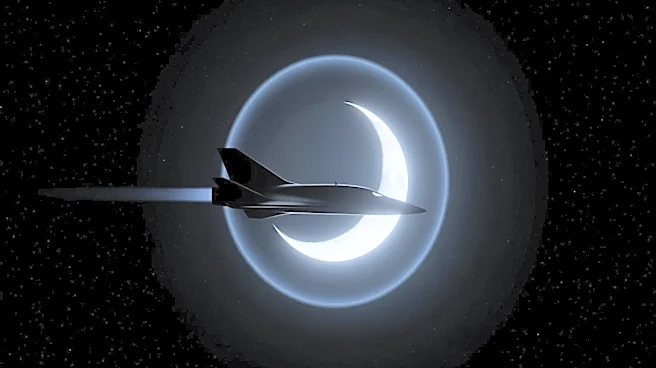
the moon fully obscuring the sun during their far-side lunar flyby. This event provided a unique opportunity to study the solar corona, the sun's outer atmosphere, which was visible as a bright halo. The eclipse lasted about 53 minutes, allowing for extended observation of the corona and background stars. The footage was captured using Orion's solar array wing cameras, offering a high-contrast view unaffected by Earth's atmosphere.
Why It's Important?
The observation of the solar eclipse from beyond the moon is significant for several reasons. It provides valuable scientific data on the solar corona, which is crucial for understanding solar activity and its impact on space weather. The extended duration of the eclipse, made possible by the Artemis 2 trajectory, allowed for detailed study of the corona's structure and brightness changes. This mission marks a milestone in human space exploration, as it demonstrates the capabilities of the Orion spacecraft and the potential for future deep-space missions. The data collected could inform the design and planning of subsequent Artemis missions, including those aimed at establishing a sustainable human presence on the moon.