







What's Happening?
The HiRO-ACEv2 system, an update to the High Resolution Output Ai2 Climate Emulator (HiRO-ACE), has been introduced to simulate extreme weather events at a 3 km resolution. Developed by Ai2, this system significantly reduces the computational cost compared
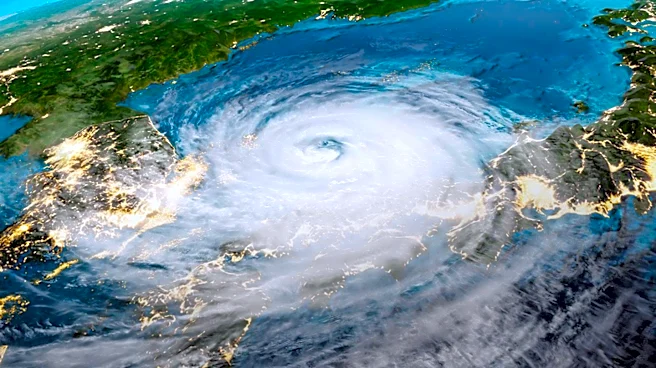
to traditional high-resolution atmospheric models like X-SHiELD, achieving simulations at approximately 1/300th of the cost. HiRO-ACEv2 comprises two main components: ACE, an AI model operating at a 100 km resolution, and HiROv2, a downscaling model that refines these coarse outputs into fine 3 km details. The updated HiROv2 can predict multiple high-resolution fields simultaneously, including rainfall, wind, and pressure, and demonstrates improved accuracy in forecasting extreme events. It can reproduce intense weather phenomena with high fidelity, matching target simulation statistics within 3% even for rare events. The system also accurately estimates tropical cyclone energy and generates realistic hurricane features, such as eyes and rain bands.
Why It's Important?
The HiRO-ACEv2 system represents a significant advancement in climate modeling and extreme weather prediction. Its ability to generate high-resolution climate data at a substantially lower cost makes sophisticated climate simulations more accessible to researchers and policymakers. This cost-effectiveness can enable more frequent and extensive simulations, leading to a deeper understanding of climate change impacts and better preparedness for extreme weather events. Accurate, high-resolution data on phenomena like hurricanes, intense rainfall, and strong winds is crucial for urban planning, infrastructure development, disaster management, and agricultural forecasting. By providing a flexible and inexpensive tool for generating long-term climate data, HiRO-ACEv2 can inform critical decisions that protect communities and economies from the escalating risks associated with a changing climate, potentially saving lives and reducing economic losses.
What's Next?
Researchers can access the HiRO-ACEv2 models and tutorial notebooks to begin utilizing the system for their climate studies. A web demo is also available, allowing users to visualize pre-generated precipitation, wind, and sea-level pressure outputs and compare them with X-SHiELD data. Future work for the HiRO-ACEv2 system includes expanding its capabilities to handle different climates, such as a 4°C warmer world, by training on new X-SHiELD datasets. The developers also plan to incorporate additional outputs like near-surface temperature, snow, and ice, which would enable new applications such as snowpack prediction. Furthermore, efforts are underway to develop a streamlined version of HiROv2 to enhance its processing speed, potentially making it more than ten times faster. These ongoing developments aim to broaden the system's utility and applicability across various climate research and forecasting needs.
Beyond the Headlines
The HiRO-ACEv2 system's innovation extends beyond mere cost reduction; it signifies a paradigm shift in how climate models can leverage artificial intelligence to achieve unprecedented detail and efficiency. By effectively downscaling coarse global climate outputs, the system addresses a long-standing challenge in climate science: bridging the gap between global climate projections and local-scale impacts. This capability is vital for understanding the localized effects of climate change, which are often the most impactful for human populations and ecosystems. The ethical implications of such powerful predictive tools are also significant, as they can inform policy decisions regarding climate adaptation and mitigation. The system's open availability and ongoing development underscore a collaborative approach to tackling one of the most pressing global challenges, fostering a community of researchers dedicated to advancing climate science and its practical applications.