



What's Happening?
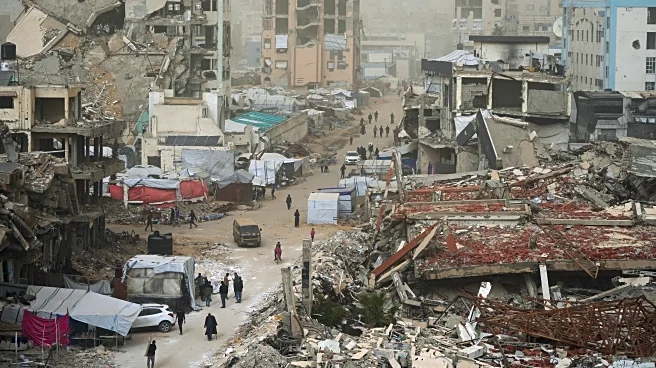
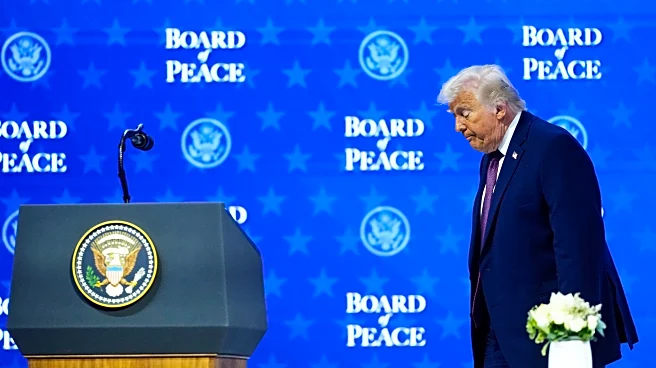
President Trump has convened the first meeting of the Board of Peace, a new initiative involving representatives from over two dozen countries. The board aims to address global conflicts, with a particular focus on the reconstruction of Palestinian territories
following a two-year conflict. Trump announced a $5 billion pledge from board members for reconstruction efforts, although this is a fraction of the estimated $70 billion needed. The board's mission has expanded beyond the initial goal of resolving the Gaza conflict to potentially rivaling the United Nations in global peacekeeping efforts. However, the initiative has been met with skepticism from some U.S. allies, who fear it may undermine the U.N.'s role. Despite this, Trump remains committed to the board's objectives, emphasizing its potential to bring about lasting peace.
Why It's Important?
The establishment of the Board of Peace represents a significant shift in U.S. foreign policy under President Trump, potentially altering the dynamics of international diplomacy. By creating a new platform for conflict resolution, the U.S. could influence global peace efforts more directly, bypassing traditional channels like the United Nations. This move could strengthen U.S. leadership in international affairs but also risks alienating allies who prefer multilateral approaches. The board's success or failure could impact U.S. relations with key global players and affect the stability of regions like the Middle East. The initiative's focus on disarming Hamas and stabilizing Gaza is crucial for regional peace, but achieving these goals will require broad international cooperation and support.
What's Next?
The Board of Peace will continue to develop its strategies for conflict resolution, with a focus on creating an international stabilization force to ensure security in Gaza. The board's operational arm, the Gaza Executive Board, is expected to provide updates on establishing governance and services in the territory. The success of these efforts will depend on the willingness of countries to contribute resources and personnel. Additionally, the board's ability to gain legitimacy and support from skeptical allies will be crucial. Future meetings and negotiations will likely address these challenges, as well as the broader implications of the board's expanded mandate.
Beyond the Headlines
The creation of the Board of Peace raises questions about the future role of international organizations like the United Nations. If successful, the board could set a precedent for alternative approaches to global governance and conflict resolution. However, it also highlights the complexities of international diplomacy, where unilateral initiatives can lead to tensions with traditional allies. The board's focus on peace in Gaza underscores the ongoing challenges in the Middle East, where political, religious, and cultural factors complicate efforts for lasting peace. The initiative's progress will be closely watched as a potential model for addressing other global conflicts.