





What's Happening?
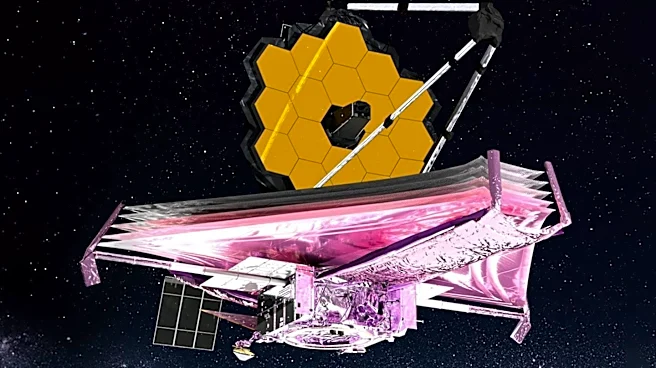
Astronomers have identified what could be the first known second-generation planet, a Jupiter-like celestial body, orbiting the white dwarf star HS 0209+0832. This discovery was made by reanalyzing 25-year-old data from NASA’s Hubble Space Telescope,
prompted by the white dwarf's unusual atmospheric composition. The star, located approximately 270 light-years away in the constellation Cetus, exhibits an atmosphere rich in elements such as zinc, copper, aluminum, silicon, titanium, and notably, niobium, which is present at levels over 1000 times that found in our Sun. Researchers from the University of Warwick-led team, whose findings were published in Nature Astronomy, propose that this planet formed from the debris expelled by the dying star. This marks a significant milestone as it is the first time a planet has been detected forming from the remnants of a stellar body, challenging previous astrophysical debates about the possibility of such formations. The putative planet is estimated to orbit HS 0209+0832 with an incredibly short period of just 4.4 days.
Why It's Important?
This discovery holds profound implications for our understanding of planetary formation and the potential for life beyond Earth. It demonstrates that planets can form even after a star's main sequence life ends, specifically from the material ejected during its death throes. This expands the known pathways for planet formation, suggesting that solar-type stars, even in their final stages, can produce new planets. The presence of niobium in the white dwarf's atmosphere is a crucial indicator, as this rare earth element is typically synthesized under the extreme conditions found inside dying stars, not through thermonuclear fusion in stellar cores. This finding opens the door to the idea that a significant number of 'second-generation' planets could exist around white dwarfs, potentially offering limited habitability. The long-term habitability of such planets is also a key consideration; as a white dwarf cools, it can maintain a stable temperature for tens of billions of years, meaning a close-in rocky planet could remain in a habitable zone for far longer than Earth's projected lifespan.
What's Next?
The detection of this potential second-generation planet around HS 0209+0832 is expected to spur further research and observation. Scientists will likely focus on observing more hot white dwarfs using instruments like the Hubble Space Telescope to identify additional candidates for second-generation planets. The unique chemical signature, particularly the presence of niobium, will serve as a key indicator in these future searches. While the current discovery involves a gas giant, the research suggests that rocky second-generation planets could also form through a similar process. Future studies will aim to determine the prevalence of these types of planets and assess their potential for supporting life. Understanding the conditions under which these planets form and evolve will be critical for refining models of planetary system development and for guiding the search for exoplanets in diverse stellar environments.
Beyond the Headlines
The concept of 'second-generation' planets forming from the remnants of dying stars introduces a fascinating new dimension to astrobiology and the search for extraterrestrial life. While a white dwarf would be much fainter than our Sun, it could still provide enough warmth for a close-in planet. However, the initial conditions for life on such a planet might differ significantly from Earth, as it would likely not receive the same molecules as our planet. This raises questions about the fundamental requirements for life and whether it can adapt to environments vastly different from our own solar system. The discovery also offers a glimpse into our own Sun's distant future; it will eventually become a white dwarf, potentially creating its own 'second-generation' planets. This long-term perspective underscores the dynamic and cyclical nature of the universe, where even stellar death can be a catalyst for new celestial formations and, potentially, new opportunities for life.