
What's Happening?
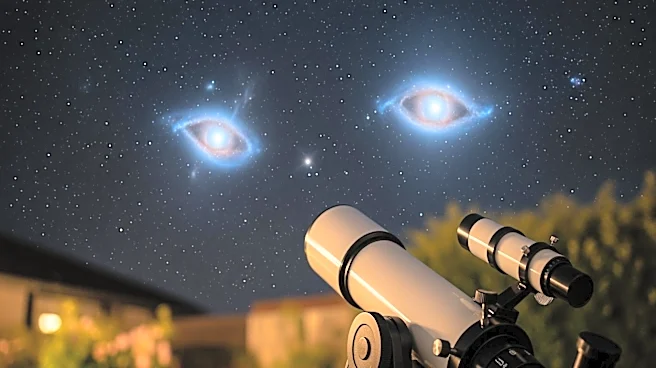
Astrophotographer Ronald Brecher has captured a remarkable image of Markarian's Chain, a series of galaxies located between the constellations Leo and Virgo. This photograph highlights the diversity of galaxies within
the Virgo Galaxy Cluster, which contains approximately 2,000 galaxies. The image prominently features NGC 4438 and NGC 4435, known as 'The Eyes,' which are two galaxies whose gravitational interactions have altered their spiral structures. Brecher used a Skywatcher Esprit 120 telescope and an astronomy camera to capture over nine and a half hours of light data from his home in Guelph, Canada. The photograph also includes the elliptical galaxies M86 and M84, discovered by Charles Messier in 1781, which are visible with binoculars or a modest telescope.
Why It's Important?
This achievement by Ronald Brecher underscores the accessibility of astrophotography and the potential for amateur astronomers to contribute to the appreciation and understanding of the universe. By capturing such detailed images from a backyard setup, Brecher demonstrates that significant astronomical observations are not limited to professional observatories. This can inspire more individuals to engage in astronomy, potentially leading to increased public interest and support for space exploration and science education. Additionally, the image provides a visual representation of the dynamic interactions between galaxies, offering insights into cosmic phenomena that can inform scientific research.
What's Next?
As interest in astrophotography grows, more amateur astronomers may invest in equipment and techniques to capture celestial events and structures. This could lead to a broader community of enthusiasts sharing their findings and contributing to citizen science projects. The increased availability of high-quality images from non-professional sources may also enhance educational resources and public outreach efforts by scientific organizations. Furthermore, as technology advances, the capabilities of amateur equipment will likely improve, allowing for even more detailed and expansive observations of the universe.
Beyond the Headlines
The cultural impact of such astrophotography extends beyond science, as it can foster a sense of wonder and curiosity about the universe. These images can serve as a reminder of humanity's place in the cosmos and the interconnectedness of all celestial bodies. They also highlight the importance of preserving dark skies, free from light pollution, to continue exploring and appreciating the night sky. This could lead to increased advocacy for environmental policies that protect natural nightscapes.