


What's Happening?
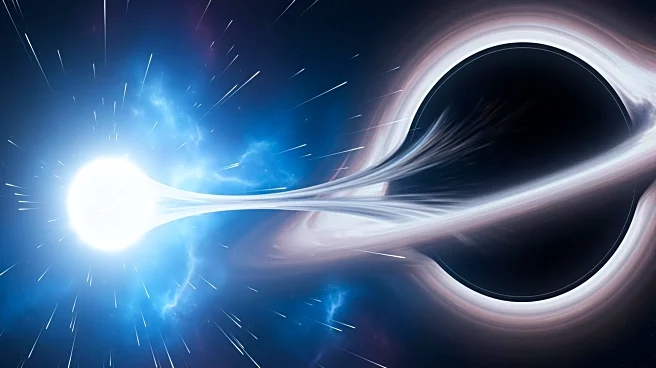
Astronomers have observed a black hole consuming a white dwarf star, marking the first direct evidence of such an event. This discovery was made by the China-led Einstein Probe space telescope in July 2025. The event, identified as EP250702a, was characterized
by a highly variable X-ray source that appeared unexpectedly, with its brightness changing rapidly. The National Astronomical Observatories of China (NAOC) reported that this X-ray transient is among the most powerful outbursts ever recorded. The unusual timing of the X-ray signal, which arrived before any gamma-ray bursts, prompted further investigation. Major observatories worldwide collaborated to track the event, noting a significant drop in brightness and a shift in X-ray emission over three weeks. Researchers from the University of Hong Kong proposed that an intermediate-mass black hole tore apart the white dwarf, producing the observed energy burst.
Why It's Important?
This discovery is significant as it provides insights into intermediate-mass black holes, a class that has been elusive to astronomers. These black holes are larger than stellar-mass black holes but smaller than supermassive black holes found at galaxy centers. Understanding this event could help fill gaps in knowledge about black hole formation and behavior. The findings also highlight the potential of multi-messenger astronomy, which uses data from various sources to study cosmic events. This approach could lead to a more comprehensive understanding of the universe's most extreme phenomena. The international collaboration involved in this research underscores the importance of global scientific partnerships in advancing astronomical knowledge.
What's Next?
The discovery of EP250702a is expected to spur further research into intermediate-mass black holes. Scientists will likely continue to analyze data from this event to refine models of black hole and white dwarf interactions. The success of the Einstein Probe in capturing this event may lead to more targeted observations of similar phenomena, potentially uncovering more intermediate-mass black holes. Additionally, the event's implications for multi-messenger astronomy could encourage the development of new technologies and methodologies for observing cosmic events, enhancing the ability to study the universe's most extreme occurrences.
Beyond the Headlines
The observation of a black hole consuming a white dwarf could have broader implications for understanding the lifecycle of stars and the dynamics of galaxies. It may also influence theoretical models of stellar evolution and the role of black holes in galactic environments. The event's documentation demonstrates the growing capabilities of space-based observatories and the importance of international cooperation in scientific discovery. As technology advances, similar discoveries could become more common, providing deeper insights into the universe's fundamental processes.