

What's Happening?
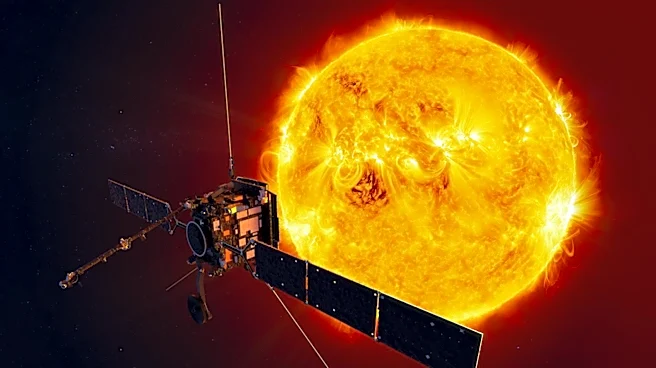
NASA's Parker Solar Probe has set a new speed record by traveling through the Sun's outer atmosphere, known as the corona, at approximately 692,000 kilometers per hour. This achievement marks the fastest speed ever reached by a human-made object. The
probe completed its 28th close approach to the Sun on June 8, 2026, following a tightly drawn elliptical orbit. The speed record was achieved during the perihelion, the closest point in its orbit to the Sun. The Parker Solar Probe's mission involves studying the Sun's corona to understand how it is heated and how the solar wind accelerates. The probe's trajectory was made possible by seven flybys of Venus, which helped adjust its orbit for closer approaches to the Sun.
Why It's Important?
The Parker Solar Probe's mission is crucial for advancing our understanding of solar phenomena that can impact space weather, which in turn affects satellites, radio systems, and power grids on Earth. By studying the Sun's corona and solar wind, scientists aim to gain insights into the processes that drive solar activity and its effects on the solar system. The probe's ability to reach unprecedented speeds and proximity to the Sun allows for direct measurements of solar particles and fields, providing valuable data that can improve predictions of space weather events. This research is vital for protecting technological infrastructure and ensuring the safety of astronauts in space.
What's Next?
The Parker Solar Probe will continue its mission, maintaining its close orbit around the Sun to collect data as the Sun transitions away from the peak of its solar cycle. NASA is reviewing the mission's next steps, including potential extensions of its operational period. The probe's continued observations will provide scientists with a comprehensive dataset to analyze solar activity under varying conditions. This ongoing research will contribute to a deeper understanding of the Sun's behavior and its influence on the solar system, with implications for future space exploration and technology development.