
What's Happening?
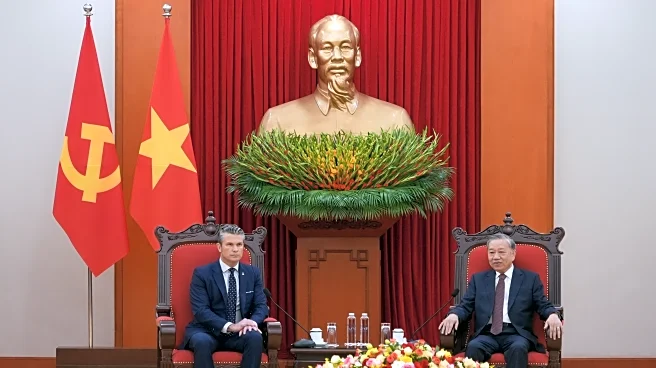
Vietnam and the European Union have elevated their diplomatic relationship to a comprehensive strategic partnership, marking Vietnam's highest level of diplomatic engagement. This development was announced during a visit to Hanoi by European Council President
Antonio Costa. The partnership aims to recalibrate trade relations amid global financial disruptions influenced by U.S. tariff policies. The EU now shares the same diplomatic status with Vietnam as the United States, China, and Russia. President Luong Cuong of Vietnam described the partnership as a 'historic milestone,' emphasizing the importance of reliable and predictable partnerships in the current international climate. The two entities had previously signed a free trade agreement in 2020, which laid the groundwork for this enhanced relationship.
Why It's Important?
The elevation of ties between Vietnam and the EU is significant as it reflects a strategic realignment in response to global trade tensions, particularly those stemming from U.S. tariff policies. This partnership could lead to increased economic cooperation and shared prosperity between the two regions. For Vietnam, aligning more closely with the EU could diversify its economic partnerships and reduce dependency on any single major power, such as the United States or China. For the EU, strengthening ties with Vietnam could enhance its influence in Southeast Asia, a region of growing economic importance. This move also underscores the EU's commitment to maintaining a rules-based international order amid rising geopolitical tensions.
What's Next?
The comprehensive strategic partnership is expected to lead to deeper economic and political cooperation between Vietnam and the EU. This could include increased trade, investment, and collaboration on global issues such as climate change and security. Both parties may work towards implementing joint initiatives that leverage their respective strengths. The partnership could also prompt other Southeast Asian nations to seek similar agreements with the EU, potentially reshaping regional dynamics. Observers will be watching for specific agreements or projects that emerge from this partnership, as well as any shifts in Vietnam's foreign policy priorities.