



What's Happening?
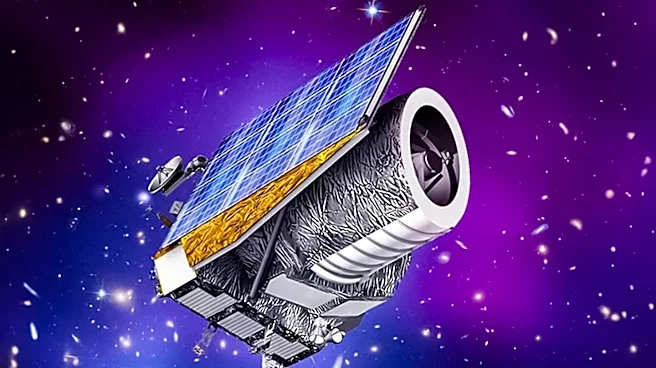
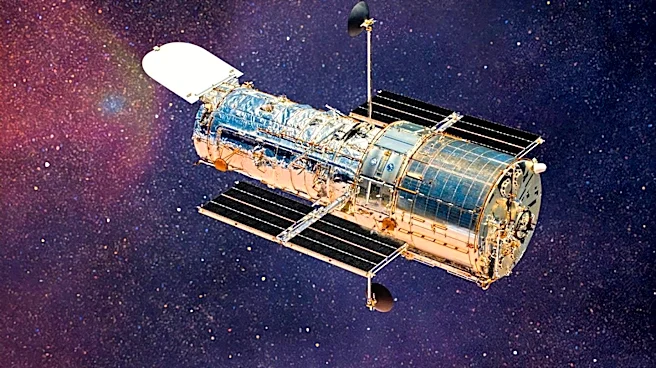
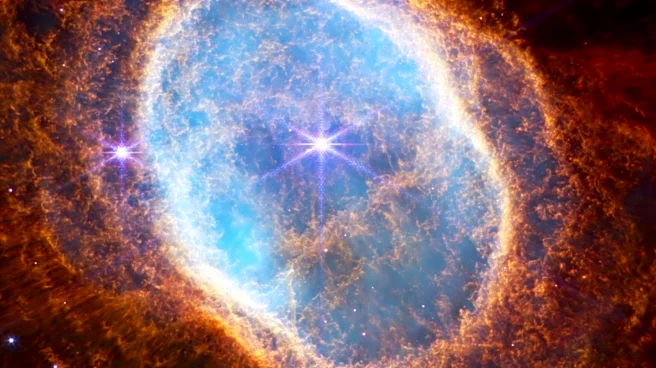
The NASA/ESA Hubble Space Telescope and the NASA/ESA/CSA James Webb Space Telescope have jointly observed a dynamic star-forming region within the Carina Nebula, approximately 7,500 light-years from Earth. This specific area, nicknamed the 'Cat's Head
Nebula' due to its distinctive shape, is a dark, elongated dust pillar. Hubble's visible-light view shows the opaque dust pillar and hints of young stars forming within, while Webb's infrared imagery penetrates the dust to reveal numerous stars and intricate structures. The 'cat's head' shape is believed to be sculpted by intense ultraviolet radiation and stellar winds from massive stars in the Carina Nebula, which erode the surrounding gas and dust, leaving denser material to resist. The glowing red 'eye' in the visible-light image may indicate a young star still embedded in dust, and a bright rim suggests gas ionized by ultraviolet radiation.
Why It's Important?
The complementary observations from Hubble and Webb are crucial for understanding the complex and often chaotic process of star formation. Hubble's visible-light data provides a surface-level view of the dust and gas, while Webb's infrared capabilities allow astronomers to peer through the obscuring dust, revealing hidden stars and internal structures. This combined approach offers a more complete picture of how stars are born within dense molecular clouds. The 'Cat's Head Nebula' serves as an excellent case study for observing the effects of stellar feedback, where powerful radiation from massive stars sculpts and erodes their birth environments. Understanding these interactions is vital for comprehending the evolution of star-forming regions and the conditions under which new stellar systems, including potentially habitable ones, emerge.
What's Next?
Astronomers will continue to analyze the detailed data from both telescopes to gain further insights into the physical processes occurring within the 'Cat's Head Nebula.' The observations will help refine models of photoevaporation and the role of massive stars in shaping their natal environments. Future studies may involve spectroscopic analysis to determine the chemical composition of the gas and dust, providing clues about the materials available for star and planet formation. As the 'Cat's Head Nebula' is a temporary structure that will eventually disperse, ongoing monitoring could reveal changes in its morphology and the emergence of new stars. The success of this collaborative observation highlights the continued importance of multi-wavelength astronomy in unraveling the mysteries of the universe.
Beyond the Headlines
The 'Cat's Head Nebula' offers a visually striking example of the universe's artistic and dynamic nature, where cosmic forces create intricate and transient structures. The concept of a 'ghostly' form rising from a 'cold mist' evokes a sense of cosmic artistry, reminding us that the universe is constantly evolving and reshaping itself. This phenomenon underscores the delicate balance between creation and destruction in space, where the very forces that give birth to stars can also sculpt and eventually disperse their nurseries. The ability of advanced telescopes to capture such detailed and evocative images not only fuels scientific discovery but also inspires a broader appreciation for the beauty and complexity of the cosmos, connecting humanity to the grand narrative of stellar evolution.