
What's Happening?
In December 2025, Mercury will reach its greatest elongation, providing a rare opportunity for skywatchers to observe the elusive planet. On December 7, Mercury will be at its furthest distance from the Sun,
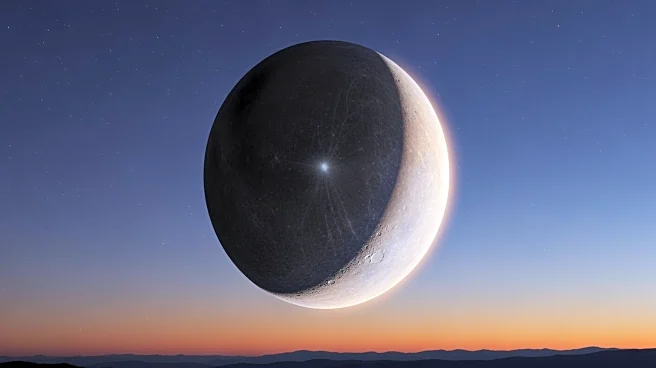
making it visible in the pre-dawn sky. The planet will shine brightly at a magnitude of -0.4, appearing as a yellowish-orange 'star'. This event allows observers to see Mercury with the naked eye, a rare occurrence due to its usual proximity to the Sun. The best time to view Mercury will be approximately 80 minutes before sunrise, offering a clear view before the Sun's glare becomes overpowering.
Why It's Important?
Mercury's visibility during its greatest elongation is significant for both amateur and professional astronomers. Observing Mercury provides insights into its orbit and behavior, contributing to our understanding of the solar system. For the public, this event is an opportunity to engage with astronomy and appreciate the dynamics of planetary motion. The visibility of Mercury can also inspire educational programs and public interest in space science, encouraging people to explore the night sky and learn more about the planets.
What's Next?
Following its greatest elongation, Mercury will gradually move closer to the Sun, becoming less visible to observers. However, the event serves as a reminder of the dynamic nature of the solar system and the opportunities for observation it presents. Astronomers will continue to monitor Mercury's orbit and behavior, contributing to ongoing research and public engagement with astronomy. Future celestial events, such as planetary alignments and meteor showers, will provide additional opportunities for observation and education.