
What's Happening?
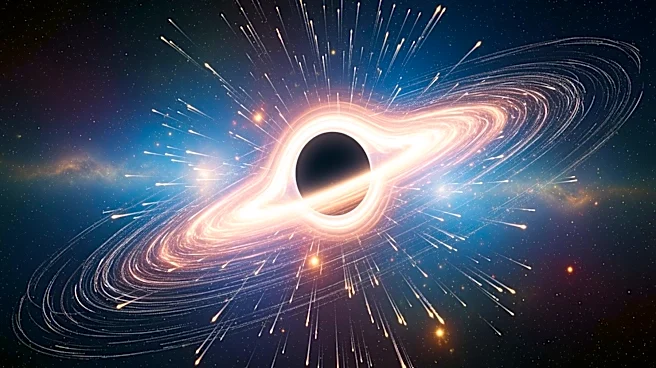
Astronomers from the University of Oxford and the Max Planck Institute for Gravitational Physics have developed a new strategy to identify tightly bound pairs of supermassive black holes. These pairs are
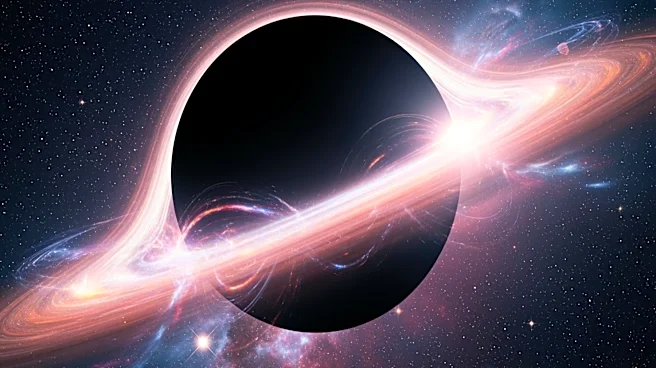
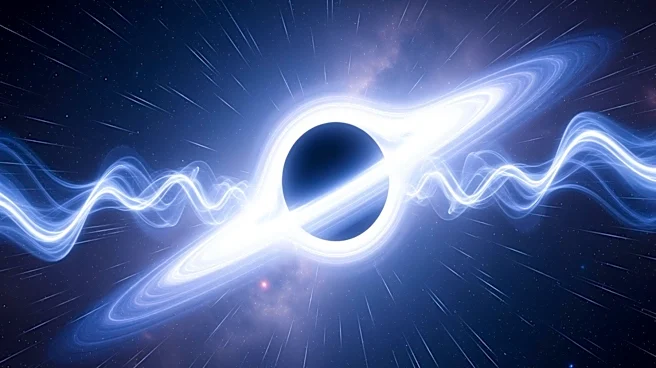
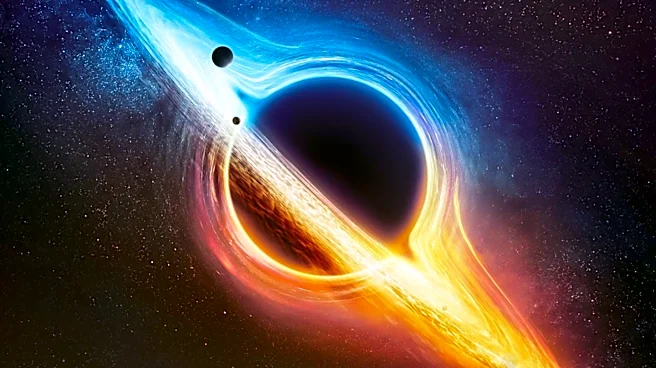
expected to form naturally after galaxies merge, but finding those that orbit closely has been challenging. The researchers suggest looking for a distinctive signal where the immense gravity of the black holes magnifies the light from stars behind them, creating recurring flashes. This method could reveal hidden systems and provide insights into galaxy evolution and gravitational waves.
Why It's Important?
The discovery of supermassive black hole binaries is crucial for understanding galaxy evolution and the generation of gravitational waves. These systems are expected to produce some of the strongest gravitational waves in the universe. Identifying them through visible light effects could allow astronomers to study these phenomena years before space-based gravitational wave detectors become operational. This advancement opens new avenues for testing gravity and black hole physics, potentially leading to significant breakthroughs in astrophysics.
What's Next?
Future observatories like the Vera C. Rubin Observatory and the Nancy Grace Roman Space Telescope are expected to enhance the search for these repeating lensing events. As these technologies come online, astronomers will have more tools to identify and study supermassive black hole binaries, furthering our understanding of the universe's most powerful forces.