







What's Happening?
Joe Tsai, chairman of Alibaba Group, announced at the 2026 World Internet Conference Wuzhen Summit that Alibaba's Qwen team has open-sourced over 470 AI models, accumulating more than 4 billion downloads globally and spawning over 330,000 derivative models.
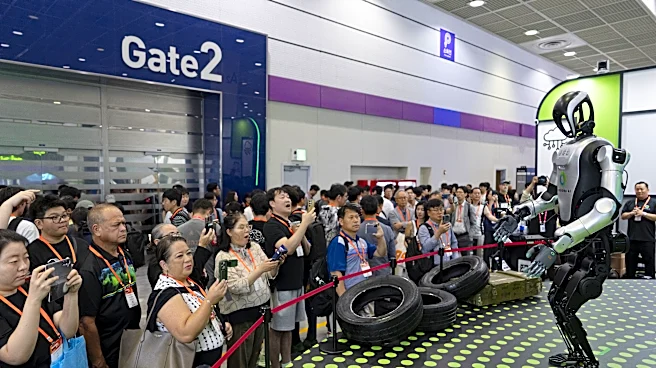
This makes it the world's largest open-source model family. Tsai emphasized that Chinese AI companies have largely adopted an open-source approach, reflecting a spirit of transcending self-interest for the common good. The summit highlighted a shift in AI competition from parameter scale to ecosystem building and industrial deployment. AI applications have expanded into various sectors, including manufacturing, healthcare, public services, and corporate work. The focus on computing power has also evolved from mere existence of chips to their affordability, with advancements in 6G and satellite internet showcased.
Why It's Important?
The shift towards open-source AI, as championed by Alibaba and other Chinese tech giants, has significant implications for the global AI landscape. By lowering the barrier to entry for developers, open-source models foster broader innovation and accelerate the development of artificial general intelligence. This approach allows smaller companies and developers in emerging economies to contribute and adapt AI to niche applications, such as minority languages and vertical industries, which larger firms might overlook. The emphasis on ecosystem building over raw parameter scale suggests a more collaborative and inclusive future for AI development, potentially democratizing access to advanced AI tools and reducing R&D costs for small and medium-sized enterprises worldwide. This could lead to a more diverse range of AI applications and solutions globally.
What's Next?
The continued push for open-source AI by major players like Alibaba suggests a future where AI technology becomes more accessible and integrated into various aspects of daily life and industry. The focus on affordability of computing power indicates that infrastructure development will be crucial, with companies striving to provide sustained, stable computing services at lower costs. This will likely drive further innovation in chip design, interconnect technology, and system architecture. The showcased advancements in 6G and satellite internet point towards enhanced connectivity, which will be vital for the widespread deployment of AI agents, especially as they move from software into the physical world, such as in autonomous vehicles and robotics. Future developments will likely involve increased international collaboration on AI governance and interoperability standards to ensure responsible and sustainable growth.
Beyond the Headlines
The widespread adoption of open-source AI models, particularly from Chinese developers, raises deeper questions about global technological leadership and data sovereignty. While promoting inclusivity and innovation, the dominance of certain open-source ecosystems could also influence future AI development trajectories and ethical frameworks. The emphasis on 'transcending self-interest' in Chinese innovation could be interpreted in various ways, potentially shaping how AI is developed and deployed on a global scale. Furthermore, as AI agents become more integrated into the physical world, ethical considerations around autonomous decision-making, job displacement, and data privacy will become even more pressing. The call for broader engagement and responsible development at the Wuzhen Summit underscores the growing recognition of these complex societal implications.