



What's Happening?
Scientists at the Vienna Institute of Technology have made a significant advancement in timekeeping by identifying a perfect site within a crystal to house thorium-229 atoms, paving the way for an ultra-precise nuclear clock. This new clock is expected
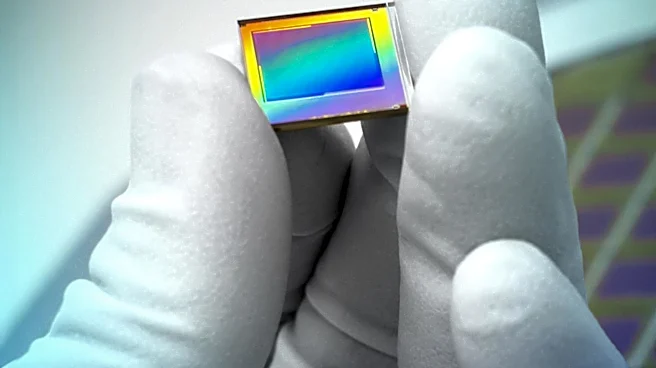
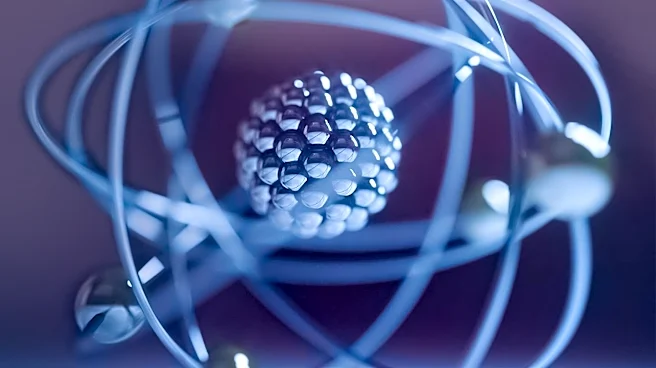
to be up to ten times more precise than current atomic clocks. Unlike atomic clocks, which measure electron energy jumps, nuclear clocks track the energy flips of a neutron inside the atom's nucleus. This method offers greater stability as the nucleus is naturally shielded by its electron cloud from external magnetic and electric fields. The research team, led by physicist Thorsten Schumm, spent 15 years perfecting the calcium fluoride crystal to ensure thorium-229 atoms could be placed in an optimal internal position, avoiding uneven electric fields that could disrupt timing. They used ultraviolet lasers to observe how thorium atoms returned to lower energy levels, identifying a specific site that emitted laser light at a single wavelength, indicating a stable environment for precise timekeeping.
Why It's Important?
The development of a nuclear clock with significantly enhanced precision has profound implications across various U.S. industries and scientific fields. Current atomic clocks are fundamental to modern infrastructure, including satellite navigation systems, global financial transactions, and advanced communication networks. A nuclear clock, being more precise and less susceptible to environmental interference, could lead to even more accurate GPS, enabling advancements in autonomous vehicles and precision agriculture. In finance, it could facilitate more precise timestamping of transactions, crucial for high-frequency trading and regulatory compliance. For scientific research, particularly in fundamental physics, a more accurate clock could open new avenues for testing theories of relativity and exploring quantum phenomena. The ability to miniaturize these clocks, as envisioned by the researchers, could also lead to their integration into smaller devices, expanding their utility beyond large laboratory settings and potentially impacting defense, space exploration, and advanced computing.
What's Next?
The Vienna Institute of Technology team anticipates that their nuclear clock prototype will achieve a precision improvement of at least three orders of magnitude by the end of the year. The primary focus moving forward is the miniaturization of the clock, aiming for a design that could eventually fit onto a small chip. This miniaturization is crucial for enabling the widespread deployment of these ultra-precise timekeeping devices in real-world scenarios. Potential applications include enhanced navigation systems, more robust communication networks, and advanced scientific instrumentation. Further research will likely involve refining the crystal growth process and optimizing the laser systems used to manipulate the thorium-229 atoms. The long-term goal is to integrate these nuclear clocks into various technologies, potentially revolutionizing fields that rely on highly accurate time measurements.
Beyond the Headlines
The pursuit of ever-greater precision in timekeeping, exemplified by the nuclear clock, reflects a deeper scientific and technological drive to understand and control fundamental aspects of reality. The inherent stability of the atomic nucleus, shielded from external perturbations, offers a glimpse into the potential for creating measurement tools that push the boundaries of what is currently possible. This advancement could lead to a re-evaluation of existing scientific constants and potentially uncover new physical phenomena. Ethically, the deployment of such precise timekeeping could raise questions about privacy and surveillance, especially if integrated into ubiquitous technologies. Culturally, it reinforces humanity's continuous quest for accuracy and control over the environment, from the vastness of space to the intricacies of quantum mechanics. The long-term shift could be towards a world where time is measured with such exactitude that it fundamentally alters our perception and interaction with the physical world, impacting everything from scientific discovery to daily technological experiences.