
What's Happening?
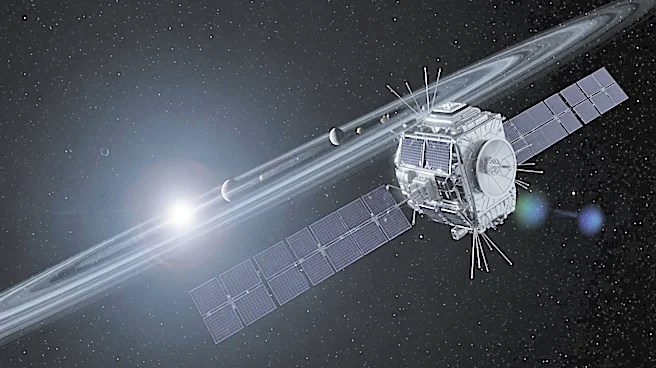
NASA has made significant advancements in asteroid detection through its Near-Earth Object (NEO) Surveyor mission, which employs advanced infrared imaging systems. The mission is designed to identify potentially
hazardous asteroids and comets using a dedicated infrared space telescope. This telescope operates near the Sun-Earth L1 Lagrange point, allowing it to continuously monitor large regions of space while minimizing observational blind spots. The mission integrates advanced thermal-control engineering, infrared detector arrays, and computational survey strategies to enhance detection sensitivity and long-term tracking performance. This initiative is part of NASA's broader effort to improve planetary defense operations by creating a robust platform for continuous deep-space observation.
Why It's Important?
The NEO Surveyor mission is crucial for planetary defense as it addresses the limitations of conventional optical telescopes, which struggle to detect small, dark objects near the Sun's glare. By using infrared sensing, the mission can detect thermal radiation emitted by celestial bodies, allowing for the identification of objects regardless of their surface brightness or reflectivity. This capability is vital for tracking asteroids that pose a potential threat to Earth. The mission's success could significantly enhance global efforts to monitor and mitigate the risks associated with near-Earth objects, thereby safeguarding the planet from potential impacts.
What's Next?
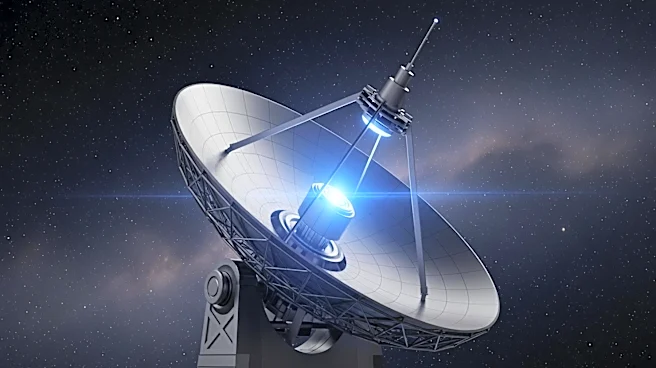
The NEO Surveyor mission will continue to transmit large volumes of observational data through NASA's Deep Space Network to the NEO Surveyor Survey Data Center at Caltech's Infrared Processing and Analysis Center. Researchers will calibrate observations, generate image catalogs, and archive infrared datasets for future scientific analysis. The mission team will also share positional measurements with planetary defense groups to support asteroid tracking and impact-risk assessment. This ongoing collaboration will be essential for refining detection techniques and improving the accuracy of asteroid tracking.
Beyond the Headlines
The mission highlights the growing role of materials engineering and thermal-control design in space-based infrared observation. It demonstrates how advanced optics and computational imaging are transforming modern detection science. The NEO Surveyor mission not only enhances asteroid-tracking capabilities but also sets a precedent for future scientific and engineering applications in space observation.