




What's Happening?
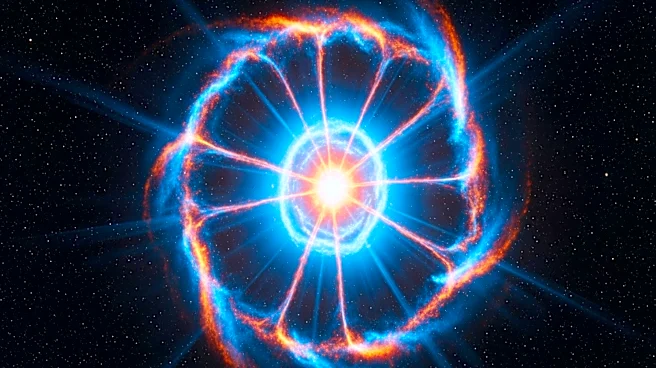
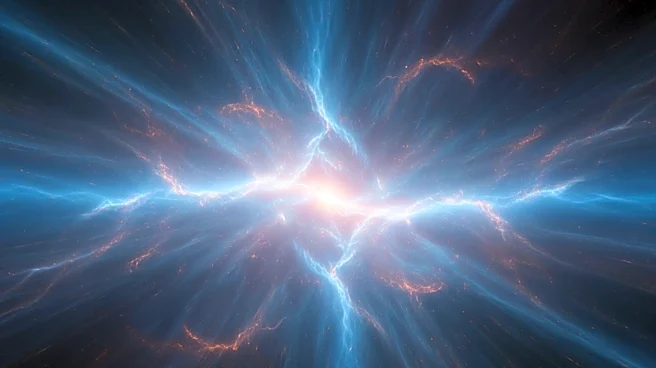
Recent simulations conducted by researchers from Kyushu University and Nagoya University have demonstrated how shockwaves from dying stars can sculpt molecular clouds into hub-filament systems, which are crucial for star formation. These simulations,
run on the ATERUI III supercomputer, show that shockwaves interact with magnetic fields within the clouds, creating pathways for gas flow that form elongated filaments leading to a central hub. This process helps explain the formation of hub-filament systems, which are observed in star-forming regions across the Milky Way. The study highlights how these structures emerge as shockwaves propagate through the clouds, amplifying sections of the magnetic field and funneling material into dense regions where stars can form.
Why It's Important?
Understanding the formation of hub-filament systems is vital for comprehending how stars are born in molecular clouds. These findings provide insights into the cosmic cycle of destruction and creation, where shockwaves from dying stars contribute to the environments that foster new star formation. This research could have significant implications for the study of stellar nurseries and the processes that govern star formation in the galaxy. By modeling the interactions between gravity, magnetic fields, and shockwaves, scientists can better understand the conditions that lead to the birth of stars, which is a fundamental aspect of astrophysics.
What's Next?
Future research will expand on these simulations to explore a broader range of cloud structures and shockwave conditions. This could help clarify why hub-filament systems vary across the Milky Way and provide new insights into the formation of massive stars and stellar clusters. The ongoing study of these processes will enhance our understanding of the complex dynamics within molecular clouds and the factors that influence star formation.