

What's Happening?
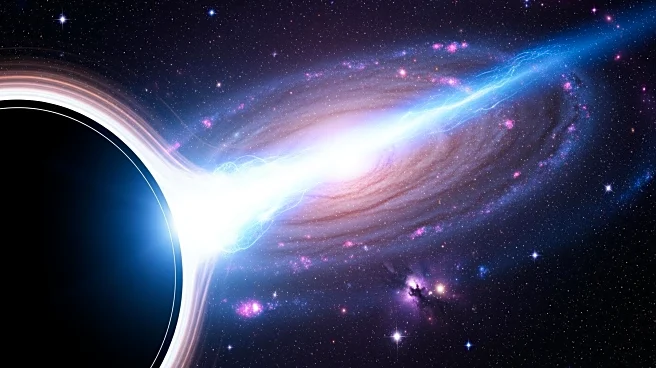
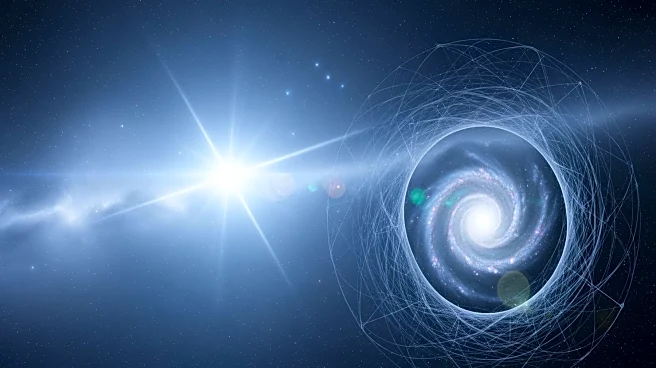
Astronomers have identified hypervelocity stars as a key tool in mapping the distribution of dark matter within the Milky Way. These stars, which travel at speeds exceeding the galaxy's escape velocity, provide valuable data on the gravitational potential
and matter distribution in the galaxy. Recent research by Chinese astronomers has focused on RR Lyrae stars, known for their predictable pulsation behavior, to identify hypervelocity candidates. By analyzing the trajectories of these stars, scientists aim to better understand the Milky Way's structure and the elusive dark matter that influences it. This research is part of a broader effort to unravel the mysteries of dark matter, which remains one of the most significant challenges in modern astrophysics.
Why It's Important?
The study of hypervelocity stars is crucial for advancing our understanding of dark matter, a component of the universe that, despite its abundance, remains largely undetected. By mapping the distribution of dark matter in the Milky Way, scientists can gain insights into the galaxy's formation and evolution. This research has implications for the broader field of astrophysics, as it could lead to breakthroughs in our understanding of gravitational interactions and the fundamental forces that shape the universe. Additionally, the findings could inform future astronomical observations and guide the development of new technologies for space exploration.
What's Next?
Future observations and analyses, particularly those involving the Gaia satellite, are expected to refine our understanding of hypervelocity stars and their origins. Continued research will focus on identifying more of these stars and analyzing their trajectories to map the Milky Way's dark matter halo more accurately. As scientists gather more data, they hope to uncover new details about the galaxy's structure and the role of dark matter in its dynamics. This ongoing research will likely contribute to the development of new theoretical models and enhance our comprehension of the universe's hidden components.