


What's Happening?
A recent study published in Science reveals that current climate models may be incomplete due to the underrepresentation of calcifying plankton, which are crucial to the Earth's carbon cycle. Led by an international team from the Institute of Environmental
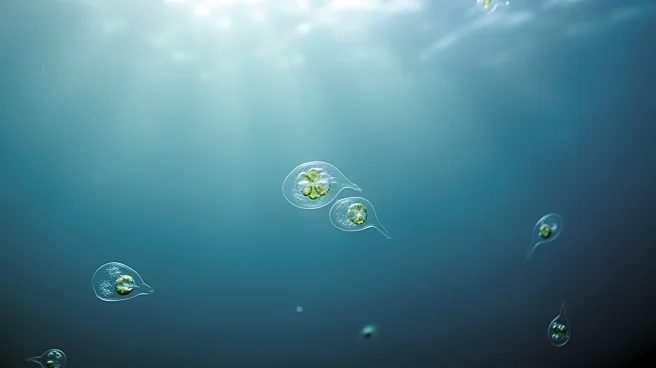
Science and Technology at the Universitat Autònoma de Barcelona, the research emphasizes the role of these microscopic organisms in regulating the planet's temperature by capturing carbon and moving it through the ocean. The study focuses on three major groups of calcifying plankton: coccolithophores, foraminifers, and pteropods. These organisms are often simplified or excluded in climate models, potentially leading to an incomplete understanding of ocean responses to climate change. The research highlights the importance of the ocean carbon pump, a process where plankton help move carbon from the atmosphere into deeper ocean layers, stabilizing Earth's climate over time.
Why It's Important?
The findings underscore the critical role of calcifying plankton in the global carbon cycle and their impact on climate models. By excluding these organisms, models may overlook key processes that affect how carbon is stored and recycled in the ocean. This omission could lead to inaccurate predictions of climate dynamics and the Earth's response to environmental stress. The study calls for improved measurement of calcium carbonate production, dissolution, and export by different plankton groups to enhance climate model accuracy. Understanding these processes is vital for predicting long-term carbon storage and interpreting sediment records used to reconstruct past climates. The research suggests that integrating detailed ocean biology into climate models could provide sharper predictions and insights into how ecosystems and societies may be affected by climate change.
What's Next?
The researchers advocate for urgent efforts to incorporate detailed data on calcifying plankton into climate models. This includes measuring the production, dissolution, and export of calcium carbonate by different plankton groups. By closing these knowledge gaps, future climate models could more accurately reflect the biological complexity of the oceans, leading to better predictions of ocean-atmosphere interactions and long-term carbon storage. The study emphasizes the need for a more nuanced understanding of how different plankton groups respond to climate threats, such as ocean acidification and rising temperatures. These efforts are essential for building the next generation of climate models that can provide deeper insights into the potential impacts of climate change on ecosystems and human societies.