



What's Happening?
The Paleozoic Era, spanning approximately 539 to 252 million years ago, was a pivotal period in Earth's history marked by the emergence and diversification of complex multicellular life. It began with the Cambrian explosion, a rapid diversification of animal
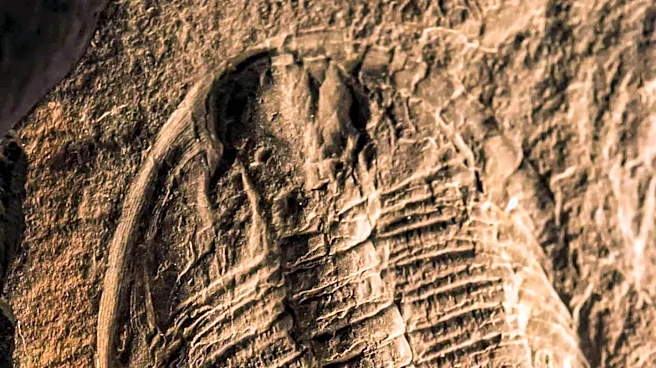
body plans where most animal phyla still alive today first appeared, including trilobites, brachiopods, early molluscs, echinoderms, and the first chordates like Pikaia from the Burgess Shale. This era also saw life transition from seas to land, leading to the development of the first forests, tetrapods, and reptiles. The Paleozoic is divided into six periods: Cambrian, Ordovician, Silurian, Devonian, Carboniferous, and Permian. Throughout these periods, significant evolutionary milestones occurred, such as the Great Ordovician Biodiversification, the appearance of jawed fish and vascular plants in the Silurian, and the formation of vast coal forests in the Carboniferous. The era concluded with the most severe mass extinction event in Earth's history, the end-Permian mass extinction.
Why It's Important?
Understanding the Paleozoic Era is crucial for comprehending the fundamental architecture of animal life and the long-term dynamics of Earth's ecosystems. The Cambrian explosion laid the groundwork for nearly all subsequent animal evolution, demonstrating a rapid evolutionary burst that shaped biodiversity. The colonization of land by plants and animals during this era fundamentally altered terrestrial environments, paving the way for complex land-based ecosystems. The repeated cycles of diversification and mass extinctions, particularly the end-Permian event, offer critical insights into the resilience and vulnerability of life in the face of drastic environmental changes. Studying these ancient events helps scientists understand the potential impacts of current climate change and biodiversity loss, providing a historical context for modern ecological challenges and the long-term consequences of geological and atmospheric shifts.
What's Next?
Ongoing paleontological research continues to refine our understanding of the Paleozoic Era. New radiometric dating techniques and fossil discoveries are constantly updating the International Chronostratigraphic Chart, potentially shifting the precise dates of period boundaries by millions of years. Future studies will likely focus on further unraveling the triggers and mechanisms behind the Cambrian explosion and the various mass extinctions, particularly the end-Permian event, which serves as a critical analogue for rapid, volcanically driven climate crises. Researchers will also continue to investigate the intricate links between life, climate, and the carbon cycle during this period, utilizing museum collections, geological field guides, and advanced analytical techniques to piece together the complex history of ancient life and environments. This continuous research will enhance our knowledge of evolutionary processes and Earth's deep past.
Beyond the Headlines
The study of the Paleozoic Era extends beyond mere historical documentation; it provides profound insights into the nature of scientific inquiry and the evolution of complex systems. The rarity of soft-bodied organism preservation, contrasted with the abundance of shells and exoskeletons, highlights the biases inherent in the fossil record and the importance of exceptional deposits like the Burgess Shale. This era also underscores the dynamic interplay between geological processes, atmospheric composition, and biological evolution. The formation of supercontinents like Pangaea, changes in ocean circulation, and the spread of land plants significantly influenced atmospheric CO2 levels and oxygen, demonstrating a deep co-evolutionary relationship between the geosphere and biosphere. The economic importance of Carboniferous coal deposits, formed from ancient forests, serves as a tangible link between deep time and modern industrial society, illustrating how past geological events continue to impact contemporary human activities and resource management.