






What's Happening?
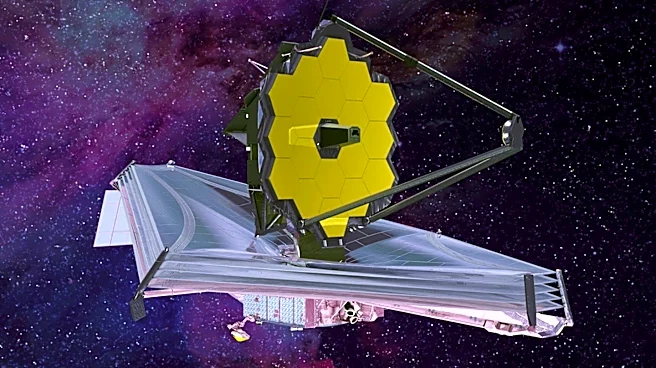
NASA's James Webb Space Telescope has discovered a new giant exoplanet, Beta Pictoris d, within the Beta Pictoris system, a well-studied planetary system in the Milky Way. This discovery increases the known planet count in the system to three. The planet was
identified through its atmospheric chemical signature rather than direct imaging, a method that could revolutionize the search for exoplanets in dusty environments. Beta Pictoris d is estimated to have at least twice the mass of Jupiter and orbits its star at a distance comparable to Neptune's orbit in our solar system.
Why It's Important?
The discovery of Beta Pictoris d is crucial as it demonstrates a new method for detecting exoplanets, particularly in systems with bright debris disks that obscure traditional imaging. This method could significantly enhance the ability to find and study planets in complex environments, providing deeper insights into planetary formation and evolution. The Beta Pictoris system serves as a model for understanding young planetary systems, and this discovery adds valuable data to the study of such systems.
What's Next?
Researchers plan to conduct further observations of Beta Pictoris d to refine their understanding of its atmospheric composition, temperature, and orbit. These studies will contribute to a more detailed picture of the Beta Pictoris system and may offer clues about the formation and dynamics of planetary systems. The new method of planet detection could be applied to other systems, potentially leading to more discoveries.