
What's Happening?
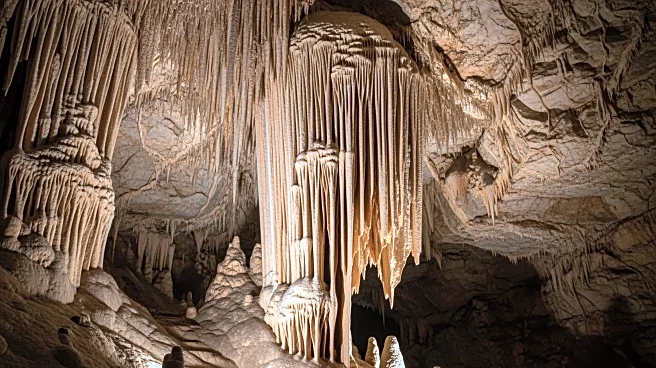
A newly discovered stalactite cave, dubbed 'Jubilee Cave,' has been found near the West Bank settlement of Ofra. The cave, featuring spectacular speleothem formations, is the largest of its kind found in Israel,
measuring 88 meters in length, 75 meters wide, and 40 meters in height. The cave is part of a broader karst system and is not accessible to the public due to its difficult and dangerous location. However, the cave is under threat from the expansion of Route 60, which passes directly above it. The expansion could lead to the cave's collapse, raising concerns among conservationists and geologists.
Why It's Important?
The discovery of Jubilee Cave is significant for both scientific and conservation reasons. It represents a unique natural formation that has developed over thousands, possibly millions, of years. The potential collapse of the cave due to infrastructure development highlights the challenges of balancing development with environmental preservation. The situation underscores the need for comprehensive planning and environmental assessments before undertaking major infrastructure projects, particularly in ecologically sensitive areas. Protecting such natural wonders is crucial for preserving biodiversity and geological history.
What's Next?
Conservationists are advocating for the protection of Jubilee Cave and the surrounding karst system. There are calls for the area to be designated as a national park to safeguard its unique geological features. The expansion of Route 60 is currently under review, and stakeholders are urging for alternative routes or protective measures to be considered. The outcome of these discussions will determine the future of the cave and its preservation. The situation also highlights the broader issue of environmental conservation in the face of development pressures in the West Bank.