







What's Happening?
Researchers have developed a method to make recycled Poly(ethylene terephthalate) (PET) more tolerant of cellulose contamination, a common issue in plastic recycling. PET, widely used in packaging and textiles with an annual global production of approximately
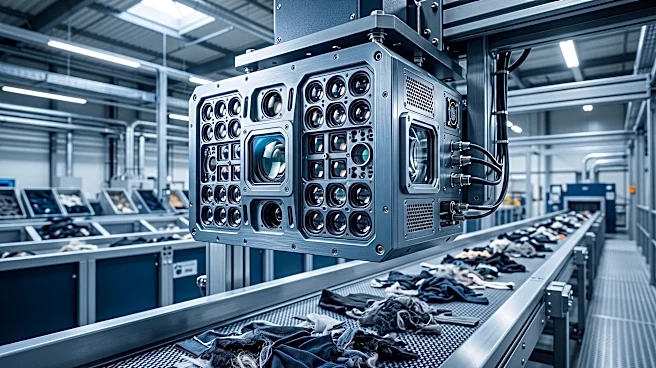
60 million tonnes, faces significant challenges in mechanical recycling due to degradation and contamination from mixed waste streams. Cellulose-rich contaminants, such as cotton fibers and paper labels, typically require costly separation and removal processes, which can reduce the amount of material recovered for recycling. This new research explores the possibility of integrating these cellulose contaminants into recycled PET under controlled processing conditions, rather than completely removing them. The study focused on creating contamination-tolerant composites by incorporating waste cellulosic fibers (WCF) into recycled PET feedstocks, aiming to preserve useful material properties. The researchers found that by carefully controlling processing parameters, including temperature and vacuum venting, and selecting appropriate PET feedstocks, they could produce composites with acceptable mechanical performance, even with 10 wt% WCF.
Why It's Important?
This development holds significant importance for the U.S. recycling industry and broader sustainability efforts. The current challenges in recycling PET, particularly the need for extensive contaminant removal, increase costs and limit the volume of plastic that can be effectively recycled. By making recycled PET more tolerant to cellulose contamination, this research could reduce the stringency required for sorting mixed waste, potentially lowering operational costs for recycling facilities. This could lead to an increase in the overall recycling rate of PET, diverting more plastic from landfills and reducing the demand for virgin plastic production. Furthermore, the ability to incorporate cellulose-rich waste into new materials aligns with circular economy principles, transforming what was once a problematic contaminant into a reinforcing agent for polymer composites. This could create new markets for recycled PET and cellulose waste, benefiting industries involved in material production, manufacturing, and waste management. The potential applications in automotive interiors and construction materials suggest a pathway for utilizing lower-quality recycled PET in valuable second-life products.
What's Next?
Future research will need to address several key areas to transition this laboratory finding into industrial application. The study did not measure sorting costs, recycling rates, life-cycle impacts, or service-life extension, which are crucial for evaluating the economic and environmental viability of this approach. Further investigation into the long-term durability of these contamination-tolerant composites under various environmental conditions, such as moisture exposure and thermal cycling, is necessary. Industrial-scale processing trials are also essential to determine the feasibility and scalability of the controlled processing conditions identified in the research. Additionally, the study used deliberately prepared waste cellulosic fibers, which differ from the diverse forms of cellulose contamination found in real-world waste streams. Therefore, future work should explore the effectiveness of this approach with more varied and complex cellulose contaminants, such as adhesive-bearing paper labels or cotton lint, to ensure broad applicability. Understanding the economic and environmental trade-offs between purification and contamination-tolerant recycling will be critical for widespread adoption.
Beyond the Headlines
The deeper implications of this research extend beyond immediate recycling efficiencies. It challenges the conventional paradigm of 'pure' recycling, where contaminants are seen as absolute impediments. By demonstrating that certain levels of contamination can be tolerated and even integrated, the study opens a new avenue for material science and waste management. This shift in perspective could lead to the development of more resilient and adaptable recycling technologies, moving towards a system that is less sensitive to imperfect waste streams. Ethically, it promotes a more resource-efficient approach, potentially reducing the environmental footprint associated with both waste disposal and virgin material production. Culturally, it could foster a greater acceptance of recycled materials that may not be 'pristine' but are functionally sound and environmentally beneficial. This research also highlights the importance of interdisciplinary collaboration between material scientists, engineers, and waste management professionals to address complex global challenges like plastic pollution, paving the way for innovative solutions that redefine waste as a valuable resource.