



What's Happening?
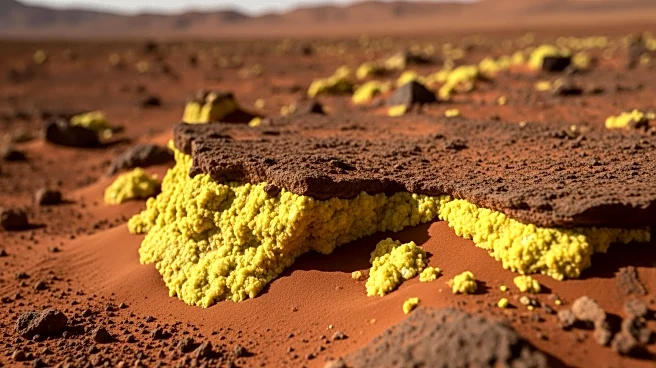
NASA's Curiosity rover has discovered pure elemental sulfur on Mars, a finding that challenges current understanding of the planet's geological history. The sulfur was found in the Gediz Vallis Channel after the rover accidentally cracked open a rock.
While sulfates are common on Mars, pure sulfur is rare and forms under specific conditions not previously known to exist in the region. This discovery suggests there may be unknown geological processes at work on Mars.
Why It's Important?
The presence of pure sulfur on Mars raises questions about the planet's geological and chemical history. Sulfur is an essential element for life, and its discovery in elemental form could provide clues about past environmental conditions on Mars. Understanding these conditions is crucial for assessing the planet's habitability and guiding future exploration efforts. The finding also highlights the importance of continued robotic exploration in uncovering Mars' secrets.
What's Next?
Further research is needed to understand how pure sulfur formed on Mars and what it reveals about the planet's history. Scientists will likely conduct detailed modeling of Mars' geological evolution to explain this phenomenon. Meanwhile, the Curiosity rover will continue its exploration of the Gediz Vallis Channel, searching for additional clues about Mars' past.