


What's Happening?
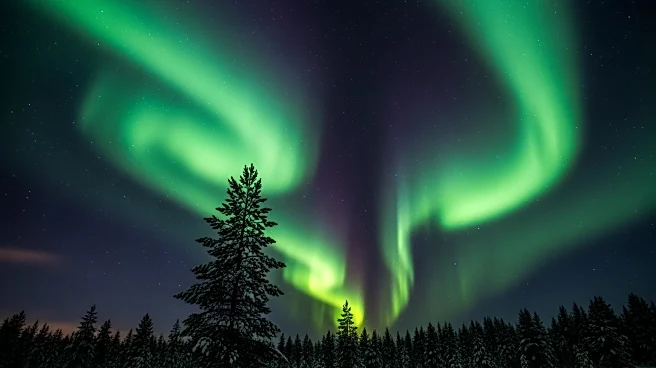
The National Oceanic and Atmospheric Administration (NOAA) has issued a geomagnetic storm watch due to a high-speed solar wind, enhancing the likelihood of Northern Lights visibility across several U.S. states and parts of Canada this weekend. The Northern Lights,
or Aurora Borealis, are typically visible in polar regions but can extend further south during periods of increased solar activity. NOAA's prediction suggests that states such as Alaska, Washington, Idaho, Montana, North Dakota, South Dakota, Minnesota, Wisconsin, Michigan, and Maine have the best chances of witnessing the auroras. The geomagnetic storm watch indicates that the auroras could be visible as far south as parts of Wyoming and New York. The best viewing times are between 10 p.m. and 2 a.m. local time, and viewers are advised to find locations with minimal light pollution for optimal visibility.
Why It's Important?
The increased visibility of the Northern Lights presents a unique opportunity for residents in northern U.S. states to experience this natural phenomenon, which is usually confined to polar regions. This event highlights the impact of solar activity on Earth's atmosphere and the potential for geomagnetic storms to affect regions beyond their typical range. The geomagnetic storm watch issued by NOAA underscores the importance of monitoring space weather, as such events can have broader implications for satellite operations, power grids, and communication systems. For the public, it offers a rare chance to witness the auroras, potentially boosting local tourism and interest in astronomy.
What's Next?
As the geomagnetic storm progresses, NOAA will continue to monitor solar activity and provide updates on aurora visibility. Residents in the affected areas are encouraged to stay informed through NOAA's forecasts and plan their viewing activities accordingly. The event may also prompt increased interest in space weather research and public engagement in scientific observation. Additionally, the occurrence of the Northern Lights in more southern regions could lead to discussions on the effects of solar activity on Earth's environment and the need for preparedness in managing potential disruptions to technology and infrastructure.