

What's Happening?
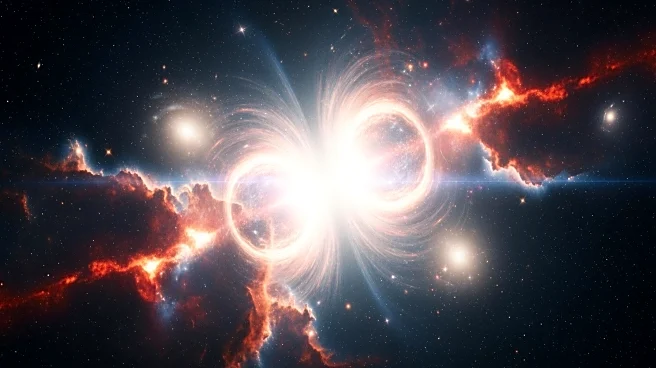
NASA's array of space telescopes, including the Chandra X-ray Observatory, the Fermi Gamma-ray Space Telescope, the Neil Gehrels Swift Observatory, and the Hubble Space Telescope, have tracked a gamma-ray burst (GRB) designated GRB 230906A to a neutron
star collision. This event was located within a small galaxy embedded in a 600,000 light-year-long gas stream, a region previously thought unlikely for such occurrences. Historically, neutron star collisions have been observed in medium to large galaxies, making this discovery significant as it suggests these events can also occur in smaller galaxies. The gas stream, where the galaxy resides, is believed to have formed from a collision of galaxies hundreds of millions of years ago, which stripped gas and dust, creating the stream.
Why It's Important?
This discovery is pivotal for astrophysics as it challenges existing theories about where neutron star collisions can occur. These collisions are crucial for understanding the creation of heavy elements like gold and silver, which are believed to form only in such extreme environments. The finding that these events can happen in smaller galaxies could explain why some GRBs appear to originate from beyond visible galaxies. Additionally, it provides insights into the distribution of heavy elements in the universe, as these elements are often found in stars far from galactic centers, suggesting that neutron star mergers could disperse them widely.
What's Next?
The research team plans to publish their findings in the Astrophysical Journal Letters, which could prompt further studies into the distribution and frequency of neutron star collisions in smaller galaxies. This could lead to a reevaluation of how heavy elements are distributed across the universe. Future observations and studies may focus on identifying more such events in similar regions, potentially altering the understanding of galactic evolution and element formation.
Beyond the Headlines
The discovery of a neutron star collision in a small galaxy within a gas stream highlights the complex dynamics of galaxy formation and evolution. It suggests that galaxy collisions can trigger star formation waves, leading to neutron star mergers over time. This finding could influence the study of cosmic history and the role of galaxy interactions in shaping the universe's structure.