







What's Happening?
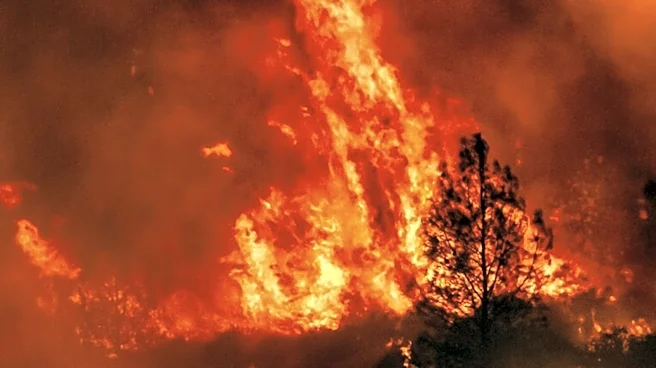
Highway 26 between Sylvan Hill and Highway 217 in Portland, Oregon, was closed through Tuesday morning following an overnight power pole fire. Tualatin Valley Fire & Rescue crews responded to the fire on SW Barnes Road late Monday night. Although the fire was extinguished,
it caused significant damage to power lines, leading to power outages for hundreds of customers and creating a hazard for both the MAX light rail line and the adjacent highway. Portland General Electric (PGE) crews worked throughout the night and morning to replace the damaged lines. The incident was attributed to a rare 'pole-top fire,' which occurs when dust and contaminants accumulate on top of a pole during dry periods and ignite when damp. The highway was reopened shortly after 10 a.m. Tuesday.
Why It's Important?
The closure of a major highway like Highway 26, a critical artery for Portland commuters, highlights the significant disruption that infrastructure failures can cause to daily life and local economies. The incident led to widespread traffic detours and impacted public transportation, including MAX train services, underscoring the vulnerability of urban transit systems to localized power issues. For Portland General Electric, such events emphasize the ongoing challenge of maintaining aging infrastructure and responding rapidly to emergencies to minimize public inconvenience and ensure safety. The 'pole-top fire' explanation also points to environmental factors, such as prolonged dry spells, contributing to infrastructure risks, which could become more prevalent with changing climate patterns. This event serves as a reminder of the intricate dependencies within urban systems and the critical role of utility maintenance and emergency response.
What's Next?
PGE crews continued emergency repairs to fully restore power to all affected customers, with power restoration timelines differing from road reopening. The incident will likely prompt further assessment of power pole maintenance schedules and fire prevention strategies, especially in areas prone to dust accumulation and dry conditions. Local authorities and transportation agencies may review emergency response protocols and communication strategies for major road closures to improve efficiency and public notification during future incidents. While the immediate crisis has passed with the highway reopening, the event underscores the need for continuous investment in resilient infrastructure and proactive measures to prevent similar disruptions, particularly as urban areas grow and become more reliant on consistent power and transportation services.
Beyond the Headlines
This incident subtly points to the broader issue of infrastructure resilience in the face of environmental changes. The mention of 'pole-top fires' being caused by dust and contaminants igniting when damp suggests a vulnerability that could be exacerbated by longer dry seasons followed by sudden moisture, a pattern potentially linked to climate change. Such events can strain emergency services and utility companies, leading to increased operational costs and potential rate adjustments for consumers. Furthermore, the disruption to the MAX light rail system highlights the interconnectedness of different infrastructure components—a power outage can cascade into public transit delays, affecting thousands of commuters. This incident serves as a micro-example of the macro-challenge of ensuring robust and adaptable urban infrastructure in an era of evolving environmental conditions and increasing population density.