
What's Happening?
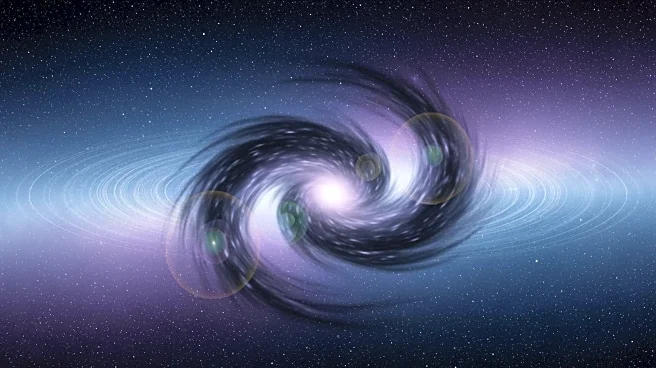
A recent study has proposed that dark matter particles, which are typically considered collisionless, may actually collide with each other, potentially reshaping galaxies from the inside out. This theory,
known as self-interacting dark matter (SIDM), suggests that these collisions could lead to significant changes in the structure of dark matter halos, which are the dense regions surrounding galaxies. Researchers James Gurian and Simon May have developed a computational tool to simulate these interactions, providing a new way to study SIDM. The study highlights the potential for these interactions to cause gravothermal collapse, where the core of a dark matter halo becomes denser over time, possibly leaving identifiable fingerprints in galaxy structures.
Why It's Important?
The implications of this study are significant for our understanding of galaxy formation and evolution. If dark matter particles do interact with each other, it could explain certain anomalies observed in the structure of galaxies that do not fit the traditional collisionless dark matter model. This could lead to a paradigm shift in astrophysics, affecting how scientists model the universe and interpret astronomical data. The ability to simulate these interactions more accurately could also enhance our understanding of the universe's fundamental forces and the role of dark matter in cosmic evolution.
What's Next?
The development of the KISS-SIDM code by Gurian and May allows for more accessible and efficient testing of SIDM models, potentially accelerating research in this area. As more astronomers and physicists use this tool, it could lead to new discoveries about the nature of dark matter and its impact on galaxy formation. Future observations and simulations may further refine these models, providing deeper insights into the universe's dark sector.