
What's Happening?
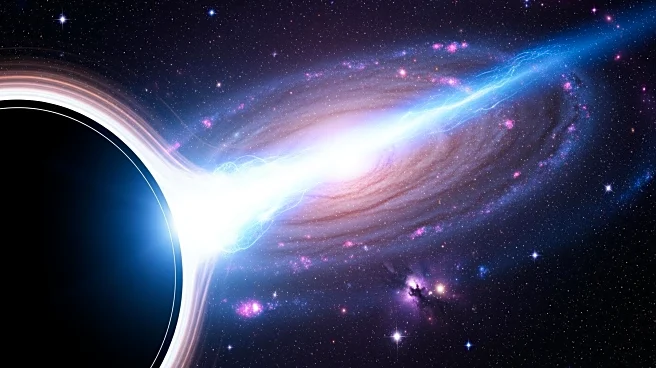
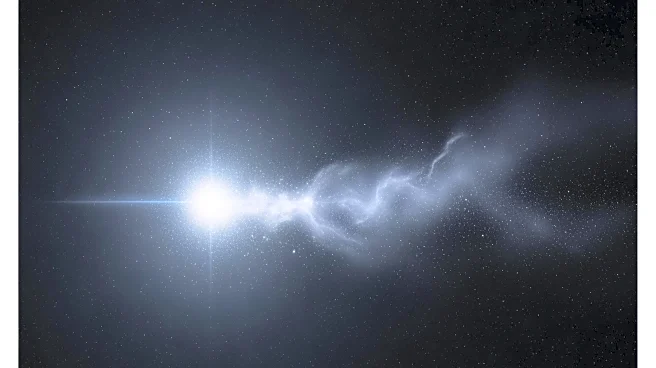
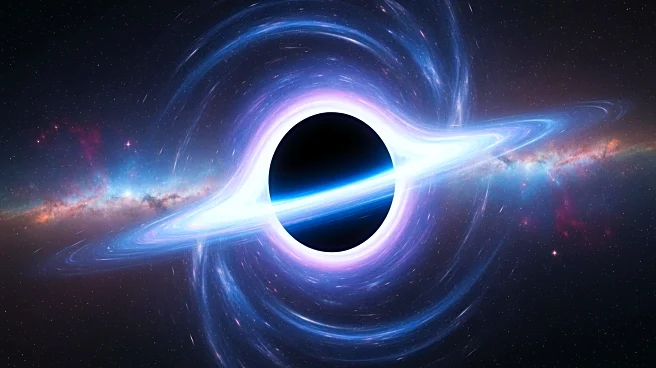
Astronomers have identified a 'mysterious disruptor' located approximately 11 billion light-years from Earth, characterized by a mass equivalent to 1 million suns and a core that may be a black hole. This
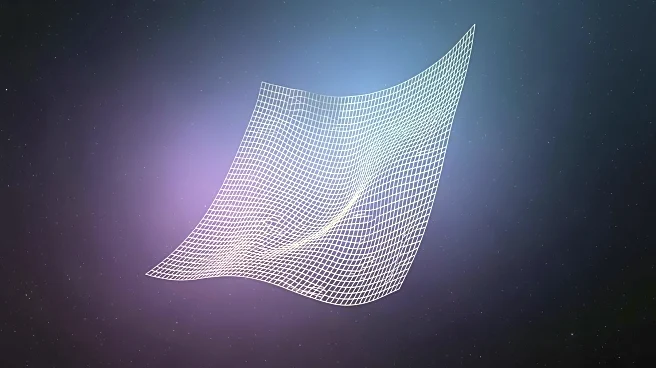
discovery was made through its gravitational effects, marking it as the most distant object detected in this manner. The object, found within the gravitational lens system JVAS B1938+666, presents a unique structure with a dense central core and a disk-like component, suggesting it could represent a new class of dark object. The research, led by Simona Vegetti from the Max Planck Institute for Astrophysics, involved complex modeling to understand the mass distribution within the system.
Why It's Important?
This discovery is significant as it challenges existing models of dark matter and cosmic structures. The 'mysterious disruptor' could provide new insights into the formation and evolution of massive cosmic bodies. Its unique structure and the method of its detection through gravitational lensing could lead to advancements in understanding the distribution of mass in the universe. The findings may also influence future research directions in astrophysics, particularly in the study of dark matter and black holes.
What's Next?
Future studies may involve using telescopes operating in different wavelengths, such as the James Webb Space Telescope, to further investigate the 'mysterious disruptor'. These observations could help determine whether the object is an ultracompact dwarf galaxy or something entirely new. Continued research may also refine models of dark matter and improve our understanding of cosmic phenomena.