



What's Happening?
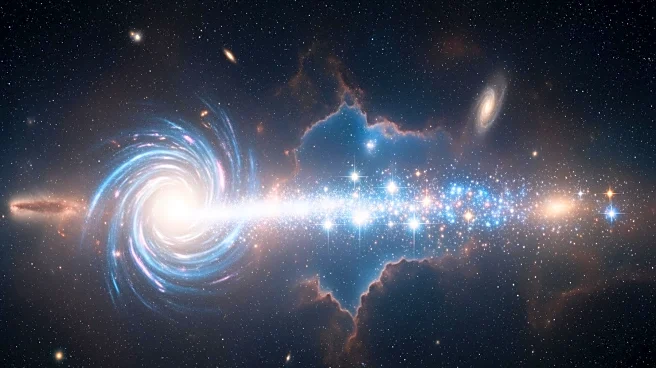
A runaway supermassive black hole, estimated to be 10 million times the mass of the sun, is racing through space at nearly 1,000 kilometers per second. This phenomenon, observed in the Cosmic Owl system, was first detected in 2023 through Hubble Space
Telescope images. The black hole, known as RBH-1, is leaving a trail of newborn stars as it moves, a result of compressing and heating the gas it encounters. This event is believed to have been triggered by a violent galaxy merger, where the black hole received a significant gravitational-wave recoil from the merging of two supermassive black holes. The James Webb Space Telescope has confirmed the black hole's speed and trajectory, providing unprecedented insights into this cosmic event.
Why It's Important?
The discovery of RBH-1 is significant as it provides the first direct evidence of a supermassive black hole escaping its host galaxy, a phenomenon long predicted by theoretical physicists. This event challenges existing understandings of galaxy evolution and the role of black holes within them. The trail of stars formed in the wake of RBH-1 suggests that such runaway black holes could contribute to star formation in intergalactic space, potentially altering the distribution of stars and galaxies. This discovery could also explain certain astronomical observations, such as galaxies with underweight black holes or missing central black holes, thereby reshaping theories about galaxy formation and evolution.
What's Next?
Future astronomical surveys, such as those planned with the Nancy Grace Roman Space Telescope and the Euclid mission, are expected to search for similar runaway black holes. These surveys will utilize machine-learning tools to identify the faint, needle-like streaks left by such black holes. As more runaway black holes are discovered, they could transition from theoretical curiosities to a recognized population, providing further insights into the dynamics of galaxy mergers and the behavior of supermassive black holes.
Beyond the Headlines
The implications of this discovery extend beyond immediate astronomical observations. The ability of a black hole to escape its galaxy and influence star formation in intergalactic space suggests a dynamic and interconnected universe. This challenges the notion of galaxies as isolated systems and highlights the potential for significant cosmic interactions. Additionally, the study of RBH-1 and similar phenomena could lead to advancements in understanding gravitational waves and their effects, offering new perspectives on the fundamental forces shaping the universe.