





What's Happening?
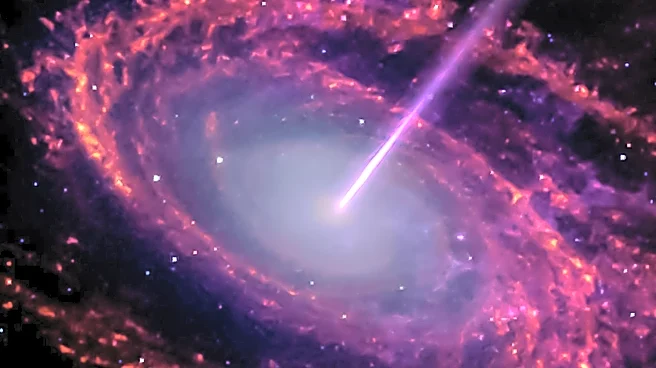
New research published in The Astrophysical Journal Letters, led by astronomers Sanchayeeta Borthakur of Arizona State University and Namrata Roy of the Raman Research Institute, provides evidence that narrow jets of heated plasma emitted by supermassive
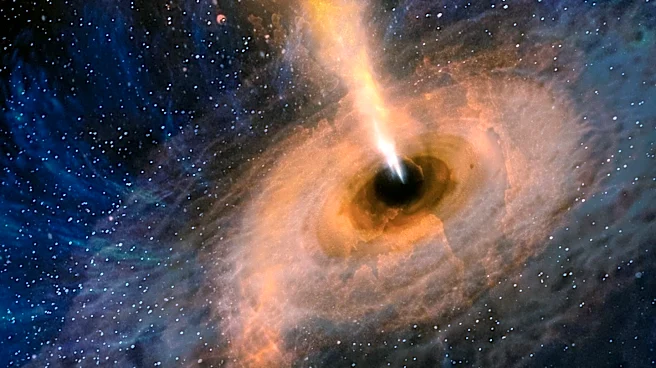
black holes significantly impact the evolution of galaxies. These jets disrupt the circumgalactic medium (CGM), a vast envelope of gas surrounding galaxies, preventing it from cooling and forming new stars. The study, which combined observations from hundreds of galaxies using data from the Dark Energy Spectroscopic Instrument (DESI) survey and radio jet measurements from the LOFAR Two-meter Sky Survey (LoTSS), found that the jets do not affect the gas uniformly. Instead, they create a distinct impression by causing the gas to shine and become ionized primarily along the radio jet's path. This ionization is brightest near the galaxy where the jet first interacts with the CGM and further out near the CGM's outer edge, where the jet releases most of its energy. This mechanism acts as a brake on galaxy growth, influencing whether a galaxy continues to form stars or becomes quiescent.
Why It's Important?
This discovery is crucial for understanding a long-standing mystery in astrophysics: why galaxies, despite being surrounded by abundant star-forming gas, do not produce more stars. The findings demonstrate a direct link between the activity of supermassive black holes and the star formation rates within their host galaxies. By showing how black hole jets can heat, stir, and disturb the gas in the CGM, the research provides a clearer picture of the processes that regulate galaxy growth and evolution. This understanding has profound implications for theoretical models of cosmology and galaxy formation, as it highlights the significant role of black holes, though relatively small, in shaping cosmic structures on a much larger scale. The ability of these jets to influence gas at vast distances, hundreds of thousands of light-years away, underscores the interconnectedness of phenomena within galaxies and the universe.
What's Next?
The study's findings offer a new framework for both observational and theoretical astrophysics. Future research will likely focus on further exploring the intricacies of the connection between supermassive black holes and galaxy evolution. Astronomers can now use the distinct signature of ionized hydrogen gas along jet paths, known as H-alpha, as a more effective tool to test how black hole jets affect galaxies. This will involve combining large optical and radio surveys to detect patterns that were previously obscured by averaging observations across all directions. The research also opens avenues for investigating how these processes might have influenced the formation of stars, planets, and ultimately, life, by understanding the distribution and availability of elements released into the universe through these cosmic events.
Beyond the Headlines
The profound implication of this research extends beyond the immediate understanding of galaxy evolution. It suggests that the seemingly small black holes at galactic centers are not isolated entities but are deeply intertwined with the fate of entire galaxies, including the potential for star and planet formation. The concept that black holes act as 'cosmic archivists,' as suggested by related research, implies that their behavior and location can preserve a record of a galaxy's assembly and growth. This connection between the micro-scale physics of black holes and the macro-scale evolution of the universe challenges previous assumptions and encourages a more holistic view of cosmic processes. It also highlights the power of combining diverse observational data and advanced simulations to uncover hidden patterns in the universe.