
What's Happening?
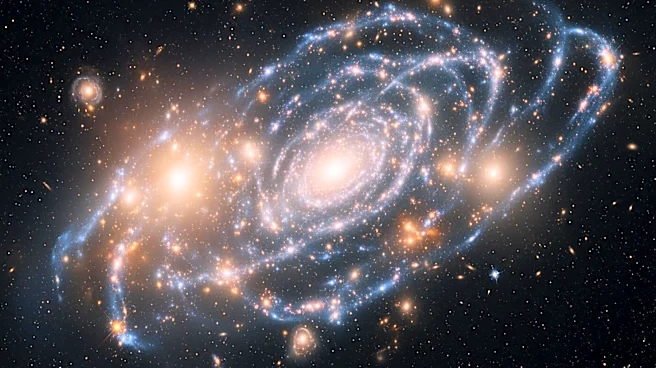
Astronomers have identified the boundary of star formation within the Milky Way's spiral disk, which extends to a radius of 40,000 light-years from the galactic center. This discovery was made by an international
team led by Karl Fiteni, using data from the LAMOST telescope, the Apache Point Observatory, and the European Space Agency's Gaia mission. The study found that the efficiency of star formation drops significantly beyond this boundary, marking the edge of the Milky Way's star-forming region. The research also revealed a U-shaped distribution of stellar ages, with the youngest stars located at this boundary and older stars found both at the center and the outer edges of the galaxy.
Why It's Important?
This finding is significant as it provides a clearer understanding of the Milky Way's structure and star formation processes. By identifying the boundary of star formation, astronomers can better understand the dynamics and evolution of our galaxy. The research also highlights the role of stellar migration in shaping the age profile of the galaxy's disk, offering insights into the mechanisms that govern galactic evolution. This knowledge is crucial for developing more accurate models of galaxy formation and evolution, which can have broader implications for our understanding of the universe.
What's Next?
Future research will likely focus on understanding the factors that cause star formation to halt at this boundary. Potential areas of investigation include the influence of the Milky Way's central bar and the warp in its spiral disk. Additionally, further studies may explore the role of radial migration in transporting stars to the outer regions of the galaxy. These efforts will contribute to a more comprehensive understanding of the Milky Way's formation history and its current structure.