
What's Happening?
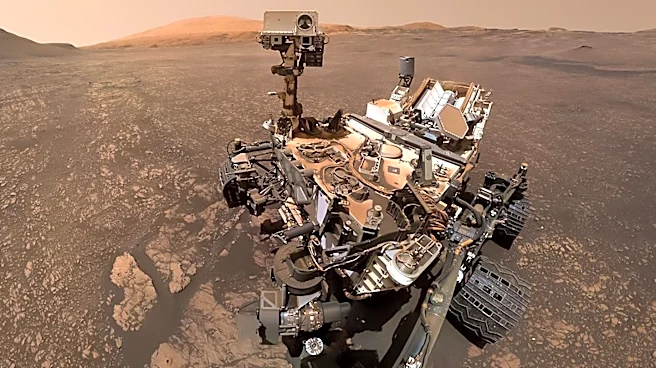
NASA's Curiosity rover has entered a unique landscape within Gale Crater on Mars, characterized by polygon-shaped ridges and scattered dark rocks. This terrain, initially perceived as smooth from orbit,
revealed a complex network of raised structures resembling a Martian honeycomb. As the rover navigates deeper, these formations become more eroded, offering insights into the environmental conditions that shaped this region billions of years ago. The presence of dark rocks, potentially meteorites, adds another layer of intrigue. Scientists are using Curiosity's instruments to analyze these features, aiming to understand their origins and the geological history of Mars.
Why It's Important?
The exploration of this unusual terrain by Curiosity is crucial for understanding Mars' geological history and the processes that have shaped its surface. The findings could provide insights into past water activity, climate conditions, and potential habitability. The discovery of dark rocks, possibly meteorites, could reveal information about Mars' interaction with space and its geological evolution. This research contributes to the broader goal of understanding Mars as a potential site for past life and future human exploration.
What's Next?
Curiosity is set to transition from the polygonal ridge field to a darker, rougher geological unit. This move will allow scientists to compare different rock formations and environmental conditions, further refining the timeline of Gale Crater's evolution. Each new terrain offers opportunities to gather data that could reshape our understanding of Mars' past. The mission continues to provide valuable information that will aid future Mars exploration missions.