
What's Happening?
Researchers have identified the largest organic molecule containing sulfur ever found in interstellar space, a discovery that could provide insights into the origins of life's chemistry. The molecule,
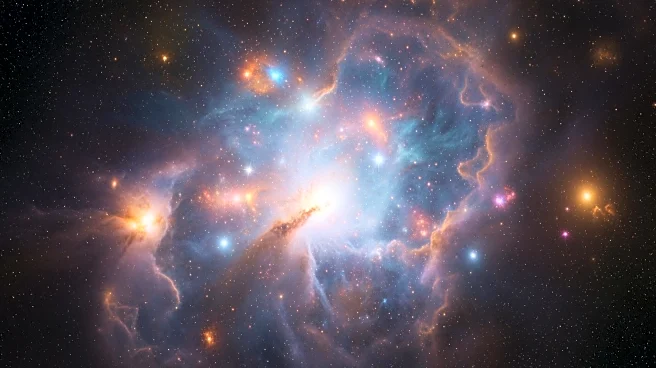
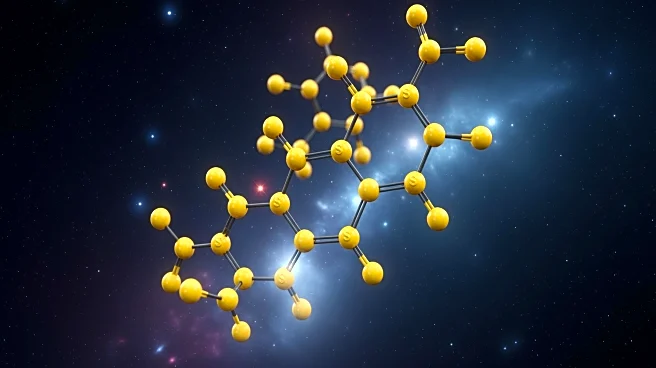
2,5-cyclohexadiene-1-thione, was detected in a molecular cloud near the center of the Milky Way, about 27,000 light years from Earth. This finding adds to a growing catalog of over 300 molecules observed in space and suggests that many more sulfur-containing molecules could be discovered in the future. Sulfur is a critical component of amino acids, proteins, and enzymes on Earth, and its presence in space could be a key to understanding how life's building blocks formed. The discovery was made by a team led by Mitsunori Araki from the Max Planck Institute for Extraterrestrial Physics, and the study was published in Nature Astronomy.
Why It's Important?
The discovery of this large sulfur-containing molecule in space is significant because it fills a gap in our understanding of the chemical processes that may have led to the formation of life on Earth. Sulfur is one of the essential elements for life, and its presence in complex molecules in space suggests that the building blocks of life could be more widespread in the universe than previously thought. This finding supports the theory that life's ingredients could have been delivered to Earth via comets and meteorites, which are known to contain complex sulfur compounds. The research highlights the resilience of molecules in the harsh environment of space and opens up new possibilities for finding life beyond our solar system.
What's Next?
Future research will likely focus on identifying even larger sulfur-containing molecules in space and understanding their role in the formation of life. Scientists may also explore the potential for these molecules to exist in other regions of the galaxy, which could provide further evidence of life's building blocks being widespread in the universe. Additionally, the study of molecular clouds and their role as stellar nurseries will continue to be a key area of research, as these environments are crucial for the formation of stars and planetary systems.
Beyond the Headlines
The discovery of complex sulfur-containing molecules in space has broader implications for our understanding of the universe and the potential for life beyond Earth. It challenges previous assumptions about the rarity of such molecules in space and suggests that the chemistry of space is far richer than imagined. This finding also underscores the importance of advanced telescopes and precise measurement techniques in uncovering the mysteries of the cosmos. As research continues, it may lead to a paradigm shift in how we view the potential for life in the universe.