



What's Happening?
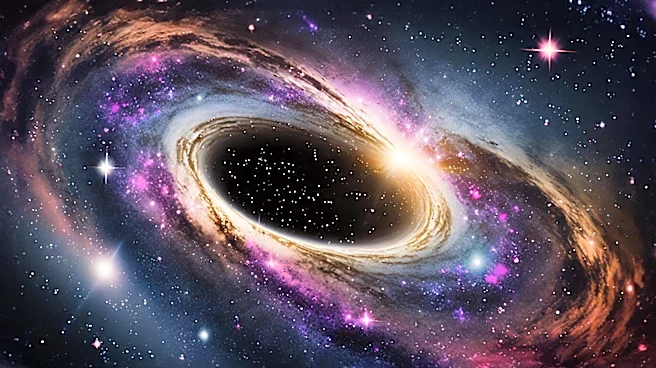
A recent study published in the journal Physical Review D, led by Professor Stefano Profumo of the University of California, Santa Cruz, has compared various dark matter scenarios, including both particle dark matter and primordial black holes. The research
utilized a single mathematical fine-tuning test, the Barbieri-Giudice index, to assess the 'naturalness' of 12 different models. Naturalness, in this context, refers to how sensitive a model's prediction for the amount of dark matter is to the values of its fundamental parameters. The study found that the formation mechanism of a dark matter model, rather than simply whether it involves particles or black holes, largely determines the degree of fine-tuning required. This challenges the common assumption that particle dark matter models are inherently more 'natural' than those involving primordial black holes.
Why It's Important?
This research is significant because it provides a standardized method for evaluating competing theories of dark matter, which constitutes the majority of matter in the universe and plays a crucial role in galaxy formation and movement. By applying a consistent quantitative measure of naturalness, the study helps to move beyond informal comparisons and subjective assessments of different dark matter hypotheses. The findings suggest that some primordial black hole scenarios are as 'natural' as certain particle models, while others, from both categories, require significant fine-tuning. This re-evaluation could influence future research directions in theoretical physics, encouraging scientists to consider a broader range of dark matter candidates and their formation mechanisms with equal scrutiny, rather than dismissing certain types of models prematurely.
What's Next?
The study does not definitively identify what dark matter is, nor does it prove that models requiring less fine-tuning are correct. Instead, it offers a common framework for assessing the sensitivity of predictions to model assumptions. Future research will likely use this methodology to further refine and compare dark matter theories. The insights gained could help guide the design of observational and experimental studies aimed at directly detecting dark matter. While naturalness can inform research, it is not a substitute for empirical evidence. Therefore, the next steps involve continued efforts to gather observational data and conduct experiments that can either confirm or rule out specific dark matter models, regardless of their perceived naturalness.
Beyond the Headlines
The study's implications extend beyond the immediate scientific community, touching upon the philosophical underpinnings of scientific inquiry. The concept of 'naturalness' in physics often reflects a preference for theories that do not require highly specific or improbable initial conditions. By demonstrating that some primordial black hole models are as 'natural' as particle models, the research encourages a more open-minded approach to theoretical physics. It highlights the potential for biases in how different classes of theories are perceived and evaluated. This work underscores the importance of rigorous, quantitative comparisons in scientific exploration, ensuring that all plausible explanations for cosmic phenomena, such as dark matter, receive equitable consideration based on their intrinsic properties rather than preconceived notions.