



What's Happening?
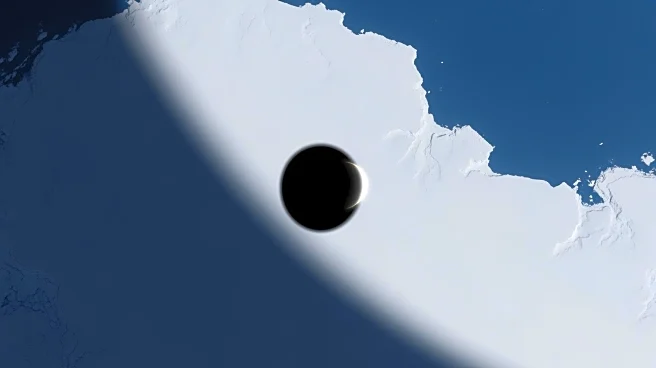
On February 17, an annular solar eclipse was observed as the moon's shadow passed over Antarctica. This event was captured by various satellites, including those from the European Organisation for the Exploitation of Meteorological Satellites and South
Korea's GEO-KOMPSAT-2A. The eclipse, visible only to those in remote Antarctic research stations, was documented from space, providing a unique perspective on the celestial event.
Why It's Important?
The satellite imagery of the solar eclipse offers valuable data for scientists studying the interactions between the sun, moon, and Earth. Such observations enhance our understanding of solar eclipses and their effects on Earth's atmosphere. Additionally, the event highlights the capabilities of modern satellite technology in capturing and analyzing astronomical phenomena, contributing to advancements in space science and meteorology.
What's Next?
Following this solar eclipse, a total lunar eclipse is expected on March 3, visible to millions across various continents. This event will provide further opportunities for observation and study, continuing the exploration of celestial mechanics and their impact on Earth. Future eclipses, such as the total solar eclipse on August 12, will also be significant for both scientific research and public engagement in astronomy.