




What's Happening?
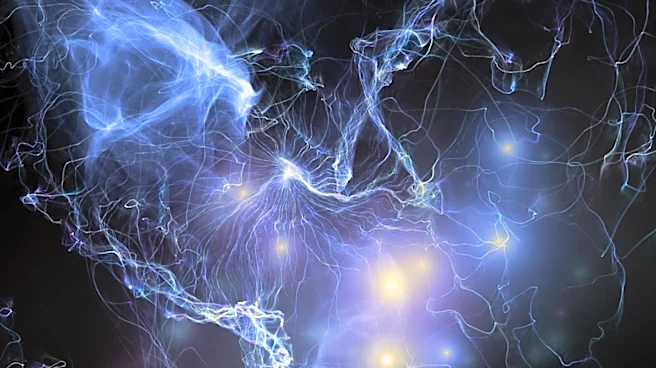
Astrophysicists from The University of Hong Kong (HKU) and Beijing Normal University (BNU) have developed a more realistic approach to testing how ultralight, or 'fuzzy,' dark matter influences gravitationally lensed images. This research marks the first
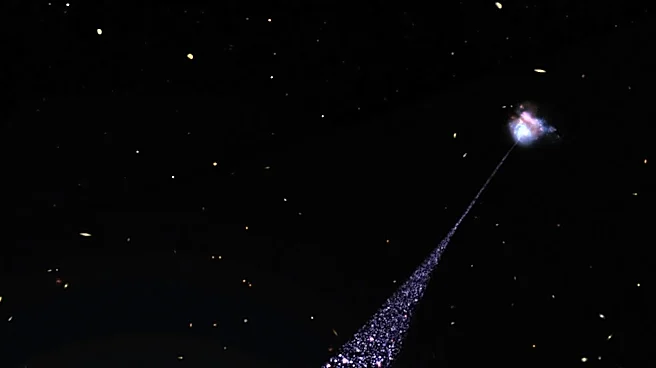
time gravitational-lensing predictions have been made directly from three-dimensional wave simulations of fuzzy dark matter. The simulations, which reproduce the observed image positions of a well-studied lensed quasar more closely than previous modeling approaches, suggest that dark matter might consist of ultralight particles that behave collectively like waves. These wave-like patterns could leave traces in multiple images of galaxies, which are formed when the gravity of a massive object distorts light from a more distant source, as predicted by Einstein's theory of gravity. The study highlights the potential of high-resolution gravitational-lensing observations to probe the nature of dark matter, a substance thought to comprise 85% of all matter in the universe but which does not emit, absorb, or reflect light.
Why It's Important?
This advancement is crucial for the field of astrophysics as it offers a new methodology to investigate one of the universe's most enduring mysteries: dark matter. The ability to simulate wave-like dark matter and its effects on gravitational lensing provides a more accurate tool for researchers to test theoretical models against observational data. If confirmed, the theory of ultralight, wave-like dark matter could significantly alter our understanding of fundamental physics, potentially leading to revisions of the Standard Model of particle physics, which currently does not account for dark matter. This research could also pave the way for more precise cosmological models, helping scientists better comprehend the formation and evolution of galaxies and the universe's large-scale structure. The findings could influence future space missions and ground-based observatories designed to detect and characterize dark matter, impacting the allocation of scientific resources and research priorities.
What's Next?
The research team plans to investigate other effects of ultralight dark matter, including changes in the brightness of gravitationally lensed images. This next step will further refine their simulations and provide additional observable signatures to test the fuzzy dark matter hypothesis. The findings suggest that gravitationally lensed systems could become a primary tool for testing ultralight-dark-matter models, potentially leading to new observational campaigns focusing on these phenomena. Future research will likely involve more extensive simulations and collaborations with other astronomical observatories to gather more data on lensed quasars and galaxies. The scientific community will closely scrutinize these results, and if validated, they could prompt a shift in the theoretical frameworks used to describe dark matter, influencing the direction of particle physics and cosmology research for years to come.
Beyond the Headlines
The implications of this research extend beyond merely identifying dark matter's properties. A deeper understanding of dark matter could unlock new insights into the fundamental forces of the universe and the very fabric of spacetime. If dark matter is indeed composed of ultralight, wave-like particles, it could suggest a more interconnected and quantum-mechanical universe than previously conceived. This could lead to a paradigm shift in physics, similar to the advent of quantum mechanics or general relativity. Furthermore, the development of more sophisticated simulation techniques for gravitational lensing could have broader applications in astrophysics, such as improving our ability to map the distribution of mass in the universe and understanding extreme gravitational environments. The ethical dimension lies in the pursuit of fundamental knowledge, pushing the boundaries of human understanding of the cosmos and our place within it.