



What's Happening?
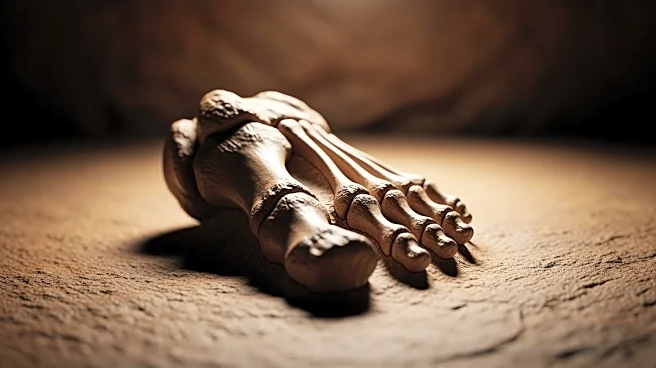
A recent study led by researchers from La Trobe University and the University of Cambridge suggests that the 'Little Foot' fossil, a nearly complete ancient hominin skeleton found in South Africa's Sterkfontein Caves, may belong to a previously unidentified
human species. Historically classified under the genus Australopithecus, the fossil has been re-evaluated and found not to fit neatly into existing species categories such as Australopithecus prometheus or Australopithecus africanus. The study, published in the American Journal of Biological Anthropology, highlights the fossil's unique anatomical features, which do not align with known species, suggesting the presence of a distinct hominin lineage at the Sterkfontein site.
Why It's Important?
The reclassification of the 'Little Foot' fossil could significantly impact our understanding of human evolution. If confirmed as a new species, it would suggest a more complex evolutionary history in southern Africa, with multiple hominin species coexisting and potentially interacting. This discovery challenges existing evolutionary models and could lead to a reevaluation of the traits and behaviors attributed to early hominins. The findings underscore the importance of careful taxonomy in paleoanthropology, as misclassification can distort our understanding of human ancestry and evolutionary processes.
What's Next?
Researchers plan to conduct further studies to confirm the classification of 'Little Foot' as a new species. This will involve detailed anatomical analyses and comparisons with other fossils from the Sterkfontein site. The study's authors emphasize the need for integrating traditional comparative anatomy with modern techniques such as 3D morphometrics and high-resolution imaging. These efforts aim to refine the evolutionary tree and provide a clearer picture of the diversity and adaptations of early hominins in Africa.