




What's Happening?
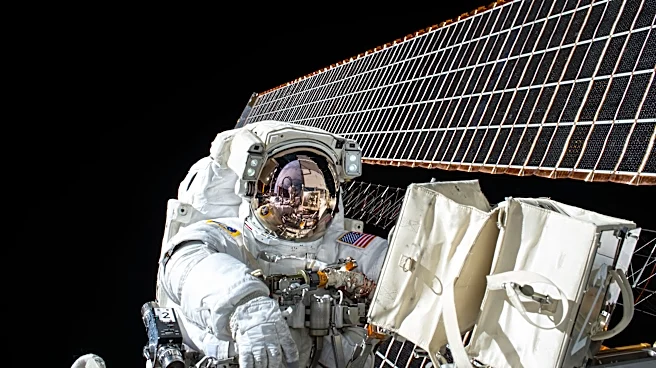
NASA's long-term exploration objectives, particularly for missions to the Moon and Mars, necessitate the development of in-space manufacturing and assembly capabilities. This strategic focus aims to enable the construction and repair of structures directly
in space, thereby reducing logistical burdens and reliance on Earth-based supply chains. Azadeh Haghighi, an assistant professor at UIC, is leading research supported by NASA through the 'Weld-ASSIST' project to advance intelligent welding technology for these purposes. The project focuses on addressing unique challenges posed by the space environment, including extreme low temperatures, vacuum conditions, and microgravity. These factors can degrade weld quality, alter material composition, and lead to defects like porosity, which are critical to overcome for reliable in-space construction.
Why It's Important?
The ability to manufacture and assemble structures in space is a critical enabler for sustainable deep-space exploration. Currently, all components for space missions must be built on Earth and launched, which is incredibly costly and limits the size and complexity of structures that can be deployed. In-space manufacturing would allow for larger habitats, more robust spacecraft, and the repair of critical systems without returning to Earth. This capability is essential for establishing permanent bases on the Moon and Mars, as it would facilitate the use of local resources (in-situ resource utilization) for construction and maintenance. Overcoming the technical challenges of welding in extreme space conditions is paramount to ensuring the safety, reliability, and structural integrity of these future extraterrestrial infrastructures, significantly impacting the feasibility and cost-effectiveness of long-duration human missions.
What's Next?
The Weld-ASSIST project, with additional NASA support, will expand its intelligent decision-support capabilities, building on a physics-informed digital twin. This involves developing multi-scale multi-physics models integrated with physics-informed machine learning and uncertainty quantification techniques to evaluate welding processes under extreme space conditions. These models will be validated through Earth-based experiments, parabolic flight tests, and existing data. The ultimate goal is to create a digital twin platform that minimizes trial-and-error, enables high-quality 'one-shot' welds in space, and reduces the need for reworks, thereby cutting costs and mission times. Future efforts will also focus on extending these technologies to utilize local materials like regolith for construction on the Moon and Mars.
Beyond the Headlines
The development of intelligent welding technology for space has profound implications beyond just space exploration. The advanced computational tools and materials science breakthroughs achieved in this research could find applications in terrestrial industries facing extreme manufacturing challenges, such as deep-sea exploration, nuclear energy, or advanced robotics. The project also highlights the growing intersection of artificial intelligence, advanced manufacturing, and fundamental physics, pushing the boundaries of engineering. Ethically, the ability to build and repair in space could reduce the environmental impact of Earth-based manufacturing for space components and open new avenues for resource utilization that minimize terrestrial resource depletion. This research also provides invaluable training opportunities for students, preparing a new generation of engineers for the complex demands of future space and advanced manufacturing sectors.