
What's Happening?
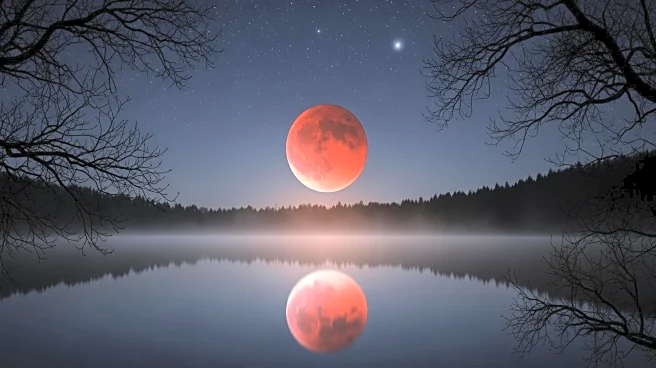
The first lunar eclipse of 2026 is set to occur in early March, with Michigan residents having the opportunity to witness a partial view of the event. Known as the 'worm moon,' this full moon will coincide
with a total lunar eclipse, creating a 'blood moon' effect. The eclipse will reach its peak at 6:38 a.m. on March 3, 2026, with the totality phase lasting from 6:04 to 7:02 a.m. Eastern Standard Time. During this time, the moon will take on a reddish hue due to the Earth's shadow, a phenomenon explained by NASA as sunlight filtering through Earth's atmosphere. The eclipse will be visible in its entirety from western North America, Australia, New Zealand, and East Asia, while Michigan will experience the moon setting during totality.
Why It's Important?
This lunar event is significant for both astronomical enthusiasts and the general public, offering a rare opportunity to observe a 'blood moon.' Such events are not only visually striking but also serve as a reminder of the celestial mechanics that govern our solar system. For Michigan, which boasts several dark sky parks, the eclipse provides an excellent occasion to promote these natural reserves and encourage public interest in astronomy. The event also highlights the importance of preserving dark sky areas, which are crucial for minimizing light pollution and enhancing the visibility of celestial phenomena.
What's Next?
As the date of the eclipse approaches, Michigan's dark sky parks are likely to see an increase in visitors seeking optimal viewing conditions. These parks, including the Headlands International Dark Sky Park and Sleeping Bear Dunes National Lakeshore, offer ideal locations for observing the eclipse. Local authorities and park officials may organize events or provide educational resources to enhance the public's understanding and enjoyment of the eclipse. Additionally, weather conditions will play a crucial role in visibility, and clear skies will be essential for an unobstructed view.