



What's Happening?
The ASTRA robotic system, developed by researchers at the California Institute of Technology, has successfully assembled an initial part of a structure in low Earth orbit without human intervention. This achievement, reported by ScienceDaily, represents
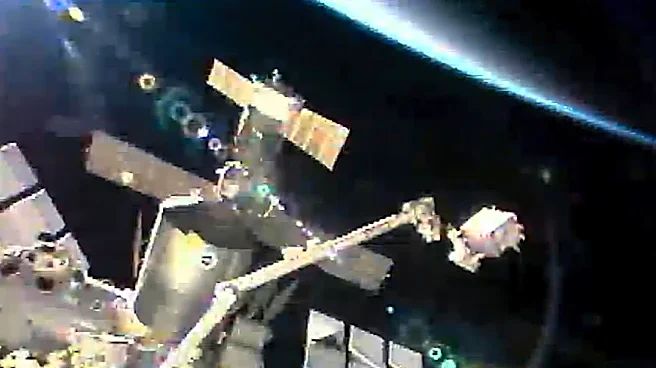
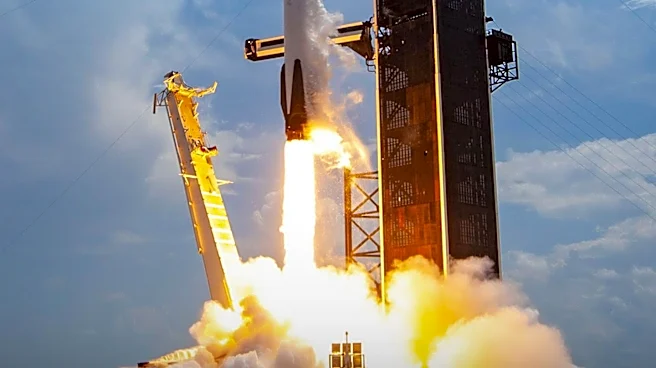
the first instance of autonomous construction in space. The project was funded by the U.S. Defense Advanced Research Projects Agency (DARPA) under its NOM4D program, which aims to test technologies for manufacturing and assembling large structures directly in space. The ASTRA system, launched on March 30, 2026, aboard the SpaceX Transporter-16 mission, retrieves composite tubes and aluminum connectors to form truss sections. During the experiment, it deployed two preassembled sections and independently created a third, intended for a 1.4-meter reflective antenna. Although the full antenna assembly was not completed due to technical difficulties and schedule constraints, the successful assembly of the initial section validates the approach for orbital construction.
Why It's Important?
This autonomous space construction by Caltech's ASTRA system holds significant implications for future U.S. space endeavors and national security. The ability to build large structures in orbit without astronaut involvement could revolutionize the deployment of critical space infrastructure. This technology could enable the construction of massive space telescopes, radio antennas, and solar arrays, which are currently limited by the size constraints of launch vehicles. For the U.S. military and intelligence communities, this means enhanced capabilities for surveillance, communication, and potentially even defense in space. It reduces the risks and costs associated with human spaceflight for construction tasks, making ambitious projects more feasible. Furthermore, it positions the U.S. at the forefront of autonomous robotics and in-space manufacturing, fostering innovation and maintaining a competitive edge in the rapidly expanding space economy. The NOM4D program's focus on structures ranging from hundreds of meters to kilometers suggests a future where orbital platforms of unprecedented scale could be a reality.
What's Next?
The Caltech team plans to continue refining the ASTRA system, addressing the technical difficulties encountered during the initial orbital assembly. Future efforts will likely focus on completing the full assembly of the reflective antenna and expanding the system's capabilities to handle more complex structures. DARPA's continued investment in the NOM4D program indicates a long-term commitment to developing and deploying these autonomous construction technologies. We can anticipate further tests and demonstrations of in-space manufacturing and assembly, potentially involving larger and more intricate designs. The success of ASTRA could also spur increased collaboration between government agencies, academic institutions, and private aerospace companies to accelerate the development and commercialization of autonomous space construction. This could lead to new opportunities for U.S. businesses in the space sector and a shift in how large-scale space missions are conceived and executed.
Beyond the Headlines
The successful autonomous assembly in orbit by the ASTRA system represents a profound shift in humanity's approach to space exploration and utilization. Beyond the immediate practical applications, this development raises ethical and legal questions regarding the future of autonomous systems in space. As robots take on increasingly complex tasks, discussions around their autonomy, decision-making processes, and potential for self-replication or repair will become more prominent. This also opens up new avenues for scientific research, particularly in materials science and robotics, as engineers strive to create more durable, adaptable, and intelligent systems for the harsh space environment. Culturally, this achievement pushes the boundaries of what is considered possible in space, potentially inspiring a new generation of engineers and scientists. The long-term implications could include the establishment of permanent human outposts or even self-sustaining colonies, as the ability to build and maintain infrastructure autonomously becomes more sophisticated.