


What's Happening?
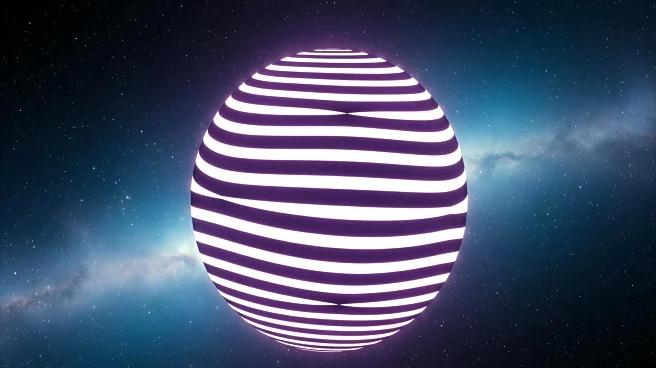
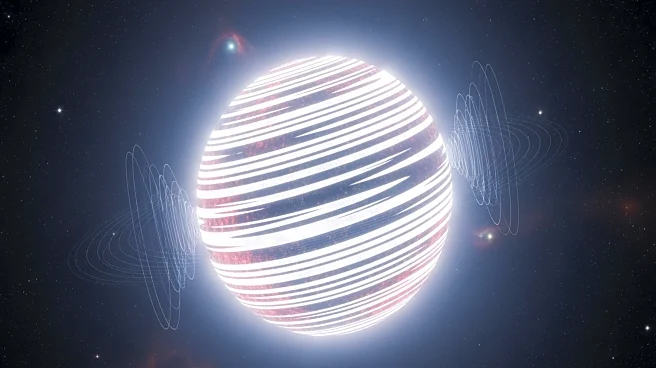
For over two decades, astronomers have been intrigued by the unique pattern of bright, evenly spaced stripes in the radio waves emitted by the Crab Pulsar, a dense remnant of a supernova. Mikhail Medvedev, a theoretical astrophysicist at the University
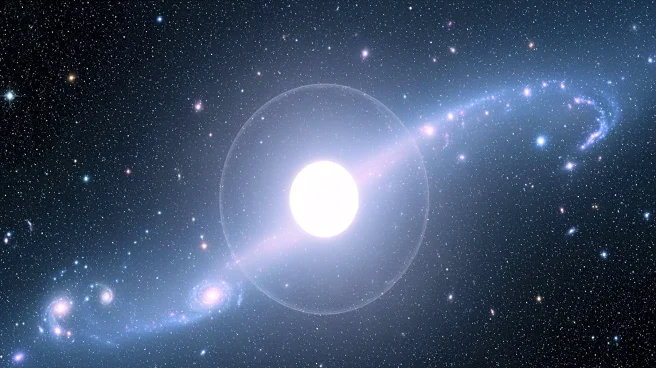
of Kansas, has identified gravity's lensing effect as the final piece needed to explain this phenomenon. Medvedev's research, which will be presented at the American Physical Society's 2026 Global Physics Summit, reveals that the combination of gravity and plasma creates a unique cosmic tug-of-war that shapes the pulsar's signal. This discovery marks the first observed case where both gravity and plasma work together to influence a signal detected from space.
Why It's Important?
This breakthrough provides a new tool for studying neutron stars and understanding the complex interactions between gravity and plasma. The Crab Pulsar's unique signal, characterized by distinct spectral bands, offers insights into the behavior of neutron stars and the distribution of matter around them. By incorporating Einstein's theory of gravity into his model, Medvedev has enhanced the understanding of how these cosmic phenomena operate. This research not only advances the field of astrophysics but also opens up new possibilities for exploring the internal structures of neutron stars and their gravitational effects.
What's Next?
Further refinements to Medvedev's model may improve the precision of these findings. While the core mechanism behind the zebra stripes is largely understood, incorporating rotational effects of the pulsar could introduce quantitative changes. This ongoing research could lead to more accurate models of rotating gravitational systems and provide deeper insights into the nature of pulsars. Scientists may also use this model to map matter distribution around neutron stars, potentially revealing new aspects of their internal structures.
Beyond the Headlines
The discovery of the Crab Pulsar's zebra stripes through the interplay of gravity and plasma highlights the intricate dynamics of cosmic phenomena. This research underscores the importance of interdisciplinary approaches in astrophysics, combining theoretical models with observational data. The findings could influence future studies on gravitational lensing and plasma interactions, offering a new perspective on how these forces shape the universe. Additionally, this work may inspire further exploration into the applications of gravitational lensing in other astrophysical contexts.