
/images/ppid_59c68470-image-177086502967212737.webp)
/images/ppid_59c68470-image-177086503363688393.webp)

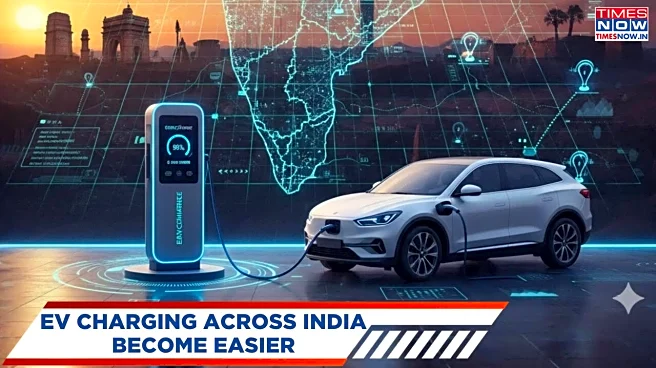
India’s electric vehicle journey is speeding up as EV penetration continues to grow across the country. To further support mass-scale adoption, the government has just announced some encouraging news for EV owners. With more people buying electric vehicles and charging them across India, the latest data shows the progress in the country's growing charging infrastructure.
According to the Vahan Portal, EV penetration, which means the percentage of EVs among all new vehicle registrations, has grown from just 0.71% in FY 2019-20 to 7.50% in FY 2024-25. This steady rise shows that more Indians are choosing electric vehicles not only to save fuel but also to enjoy smoother rides, lower running costs and eco-friendly benefits.
How EV Charging Is Becoming
Easier Across India -
One of the common worries for EV buyers has been, “Where will I charge my EV?”, “Are the chargers available easily across India?” “Can we go on long routes with our electric cars?”
But now, due to major government schemes, new charging stations and incentives for manufacturers, charging is becoming more convenient in both cities and on highways. Companies are opening fast-charging stations at fuel pumps, malls, parking lots and even remote locations.
Government Support Behind EV Growth -
1. PLI Scheme for Automobile and Auto Components (Rs 25,938 crore)
Started in September 2021, this scheme helps companies produce electric vehicle parts and advanced technology components in India. Manufacturers must ensure at least 50% of components are made locally.
2. PLI Scheme for Advanced Chemistry Cell (ACC) Batteries (Rs 18,100 crore)
Approved in May 2021, this scheme supports the manufacturing of modern battery technology in India. It aims to create 50 GWh of domestic battery production capacity, which will make batteries cheaper and more accessible in the future.
3. PM E-DRIVE Scheme (Rs 10,900 crore)
Launched in 2024, this scheme will run till March 2028 and supports -
⦁ Electric two-wheelers
⦁ Electric three-wheelers
⦁ Electric buses
⦁ Electric trucks
⦁ Electric ambulances
It also boosts India’s charging infrastructure and helps testing agencies upgrade to international standards. The government also encourages domestic production of EV parts so India can rely less on imports.
What This Means for EV Owners and New Buyers -
Improved EV infrastructure and more charging stations mean less range anxiety and decreased costs due to local manufacturing of batteries and EV parts. It will also give better safety and faster charging, due to newer technologies. As the charging infrastructure keeps improving with time, buyers will get more model choices in EV two-wheelers, cars, autos, trucks and buses.
EV Growth in India -
Electric vehicle adoption in India has grown at an exceptional pace over the past six financial years. In 2019-20, EVs accounted for just 0.71% of total vehicle registrations, with 1.74 lakh electric vehicles registered against 244.20 lakh petrol and diesel vehicles. Although the numbers were small, this marked the early beginning of India’s shift toward cleaner mobility.
The following year, in 2020–21, EV penetration increased slightly to 0.82%, with 1.43 lakh EVs registered compared to 173.79 lakh internal combustion engine (ICE) vehicles. While this growth seemed modest, it signaled a steady rise in consumer interest, even during a year affected by pandemic-related disruptions.
A major jump came in 2021-22, when EV registrations climbed to 4.59 lakh, pushing EV penetration to 2.49%. This was the first time India saw EV numbers rise on a larger scale, largely due to the growth of electric two-wheelers and improved awareness about electric mobility.
Also Read: 2025 Harley-Davidson CVO Street Glide - Checkout Price, Specs, Design And More
The upward trend continued in 2022-23, with EV registrations reaching 11.83 lakh and penetration rising to 5.30%. Better product choices, falling running costs, and early government incentives contributed to this boost. Over time, electric vehicles were no longer viewed as experimental but they were becoming a practical choice for many buyers.
In 2023-24, this momentum grew further as EV registrations increased to 16.81 lakh, raising the EV share to 6.82%. This period also saw the expansion of charging networks and stations, which grew trust in EV performance and manufacturers also gave more competitive pricing.
Finally, in 2024-25, India reached its highest EV adoption level yet, with 19.68 lakh EVs registered and a penetration rate of 7.50%. Electric vehicles have become a visible and growing part of India’s automotive market. The rise shows how quickly consumer preferences are shifting and how supportive policies and infrastructure growth are helping EVs become mainstream.
India is moving strongly toward cleaner mobility and with the current pace, EVs may soon become as common as ICE vehicles.
For more two wheeler, three wheeler and auto industry updates, stay tuned to Times Now Auto.
/images/ppid_59c68470-image-177086764282223684.webp)

/images/ppid_59c68470-image-177086759373551157.webp)
/images/ppid_59c68470-image-177086765360591863.webp)
/images/ppid_59c68470-image-177086752613988666.webp)
/images/ppid_59c68470-image-177086755389791037.webp)
/images/ppid_59c68470-image-177086754180562210.webp)


/images/ppid_a911dc6a-image-177086565159830523.webp)


/images/ppid_a911dc6a-image-177086525988983382.webp)