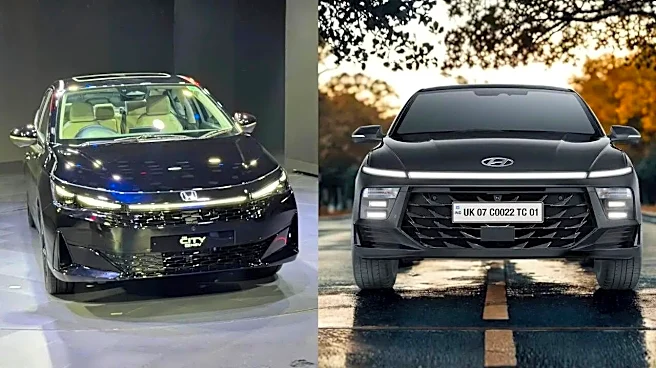




The 2026 Honda City facelift is now on sale in India with a refreshed design, updated features and revised variant lineup. Its arrival puts the spotlight back on one of its strongest rivals, the Hyundai Verna. While both sedans target buyers looking for a premium family car, they take very different approaches. The City sticks to its tried-and-tested formula of comfort and refinement, whereas the Verna leans heavily on technology, safety features and performance. For buyers planning to spend around Rs 12 lakh to Rs 20 lakh on a sedan in 2026, the choice is no longer as straightforward as it once was.
Price-wise, the 2026 Honda City facelift is priced between Rs 11.99 lakh and Rs 20.99 lakh (ex-showroom), including the strong-hybrid variant, while
the Hyundai Verna range starts at Rs 10.98 lakh and goes up to Rs 18.40 lakh (ex-showroom).
Honda City Facelift Vs Hyundai Verna: What Do You Get?
Honda hasn't reinvented the City with this update. Instead, the company has focused on sharpening an already familiar package. The sedan gets a revised front-end design, updated lighting elements and new alloy wheels. Inside, the layout remains largely unchanged, which will be reassuring for existing Honda owners.
The Verna continues with the design that helped it stand out when it was launched. At 4,535 mm long with a 2,670 mm wheelbase, it has a noticeably stretched appearance. The City measures 4,583 mm in length but rides on a shorter 2,600 mm wheelbase.
Feature-wise, Hyundai continues to play aggressively. The Verna offers dual 10.25-inch screens, ventilated front seats, an 8-speaker Bose audio system and connected car technology. The City covers the essentials well but does not match the Verna's equipment list at the top end.
Safety is another area where both cars score strongly. Six airbags are offered, while ADAS technology is available on higher variants of both sedans.
Performance: One Clear Winner
Let's now come to the mechanical side of things. The Honda City uses a 1.5-litre naturally aspirated petrol engine producing 119 bhp and 145 Nm. Buyers can choose between a 6-speed manual gearbox and a CVT. The hybrid setup puts out 124.48 bhp along with 253 Nm of torque. It is paired to an e-CVT unit.
The Verna offers two engine choices. Its 1.5-litre naturally aspirated petrol develops 113 bhp and 114 Nm with 6-speed manual or IVT. However, the highlight figure for the Hyundai model comes from the 1.5-litre turbo-petrol engine, which delivers 157 bhp and 253 Nm and is mated to either a 6-speed manual or a 7-speed DCT transmission.
Buyers who enjoy quick overtakes and effortless highway performance will immediately notice the difference.
Also Read: New Honda City vs Old - Price, Design, Features And What’s Changed?
Which One Should You Buy?
The answer depends on what matters most to you. The Honda City remains a sensible pick for buyers who value a refined petrol engine, comfortable rear seat and a model that has built a strong reputation over the years. The facelift makes it feel fresher without changing its core character.
The Hyundai Verna, meanwhile, offers more for buyers who prioritise features and performance. The turbo-petrol variant, in particular, gives it an edge that few rivals can match.
If your priority is a comfortable and predictable family sedan, the City still makes a strong case. If you want more technology, more power and a broader range of choices, the Verna is the sedan that feels harder to ignore in 2026.
/images/ppid_a911dc6a-image-177974423064541871.webp)

/images/ppid_a911dc6a-image-177974303077078709.webp)






/images/ppid_a911dc6a-image-177973952518218396.webp)