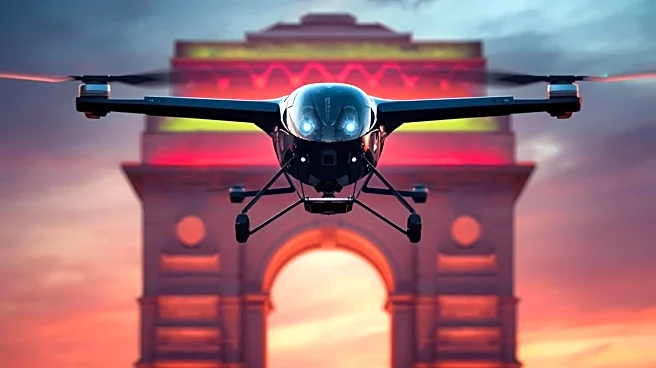

With congested urban cities being a common problem across nations, the idea of having flying taxis has fascinated both engineers and daily commuters for decades. Once a concept portrayed in cartoons and science
fiction movies, commuting by air has now become a lot closer to reality than we think. Today, China, the United Arab Emirates (UAE) and the United States are pioneering air taxi programs, while India has already showcased the Shunya eVTOL air taxi at the Bharat Mobility Expo 2025. Here's why low-altitude flying is getting democratized a lot sooner than we imagined globally.
The fundamental benefit of the 'flying taxi' concept is reduced traffic, less pollution and improved connectivity across locations with high traffic density. The technical term for these small aircraft is electric Vertical Take-Off and Landing craft (eVTOL). The aircraft is generically compact, noiseless and even autonomous in some cases. According to a Global Market Insights report, the market value of the eVTOL industry was USD 772 million in 2024. This is estimated to grow to USD 11.75 billion by 2034, with urban congestion, advancement in EV technology and rising investments being key growth drivers.
So clearly, there is a first-mover advantage to be made here for countries that will develop, operate and most importantly tackle regulations and approvals. China has taken the lead by becoming the first country to approve autonomous flying taxis. With several aviation startups such as Aridge catching up quickly, Chinese manufacturers have begun mass production of eVTOLs backed by government policy and regulation support. The UAE had signed an agreement in 2024 to launch aerial taxis in Dubai by 2026 between the Road Transport Authority and Joby Aviation. The Joby S4 is designed to carry four passengers and a pilot with a maximum range of 161 km and a top speed of 321 kmph. The United States rolled out Donald Trump's Advanced Air Mobility National Strategy on December 17 to support and ramp up its domestic eVTOL operations over the next 10 years.
Meanwhile, India's Shunya eVTOL air taxi prototype is expected to get production-ready soon. The electric flying taxi service is expected to launch in Bengaluru by 2028 and the eVTOL has a range of 160 km and a top speed of 250 kmph. Once operations begin, flying in the Shunya eVTOL is expected to cost passengers as much as any other premium taxi service in the region. After Bengaluru, the air taxi service will expand to other major cities such as Delhi, Mumbai and Pune. Once live, the air-taxi service would help cut down travel time across major cities and as adoption levels increase, it can potentially lead to less traffic density on the roads.
While the technology may catch up, it remains to be seen if policy, regulations and infrastructure of the country will be able to do the same. It would also define India's place in the global eVTOL market in the next decade and lead to reduced congestion and commuting periods. More importantly, the rise of eVTOLs in major Indian cities such as Delhi would lead to better management of critical emergencies. For example, the low-altitude aircraft can serve as an effective air ambulance or assist in disaster management.
/images/ppid_a911dc6a-image-177060802130265096.webp)










/images/ppid_59c68470-image-177046504002345104.webp)