

/images/ppid_59c68470-image-177069787096999621.webp)
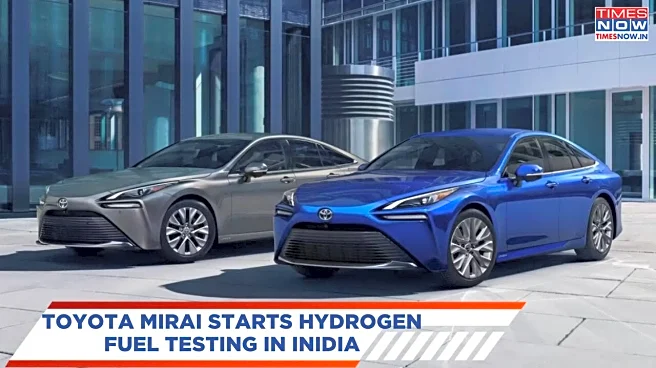
Hydrogen-powered cars may soon become a familiar sight on Indian roads, as Toyota Kirloskar Motor (TKM) has officially partnered with the National Institute of Solar Energy (NISE) to test the Toyota Mirai, which is one of the world’s most advanced hydrogen fuel-cell electric vehicles (FCEVs) under real Indian conditions.
TKM recently signed a Memorandum of Understanding (MoU) with NISE in New Delhi, which handed over the Toyota Mirai to the institute for a detailed performance study. The signing included Union Minister for New and Renewable Energy, Pralhad Joshi, who emphasized that India’s clean energy transition is now moving from “planning to implementation.” This partnership supports India's National Green Hydrogen Mission, which is a government
initiative aimed at reducing dependence on conventional fuels and promoting carbon-neutral mobility.
Also Read: Maruti Alto K10 Vs Tata Tiago - Engine And Mileage Comparison
What Will Be Tested in the Mirai?
The study will evaluate how the Toyota Mirai performs in everyday Indian environments, which includes- Fuel efficiency and driving range across different regions, vehicle behavior in city traffic, highways, and rough terrains, refueling patterns and ease of use and performance in India’s diverse climate, including heat, dust, humidity, monsoon rains, and even cold regions. These detailed testing will help determine how practical hydrogen-powered vehicles can be for Indian consumers.
How the Toyota Mirai Creates Electricity from Hydrogen
Unlike petrol or diesel vehicles, the Toyota Mirai uses a hydrogen fuel-cell system and here’s how it works-
- Hydrogen stored in the tank enters the fuel-cell stack
- It reacts with oxygen from the air
- Electricity is produced to power the motor
- The only emission is water vapour
Why This Testing Matters for India
The data collected by NISE will be crucial in understanding how India can adopt hydrogen mobility. It will support infrastructure planning, such as hydrogen production and refueling stations and help determine the Mirai’s suitability for Indian road conditions.
TKM’s leadership believes hydrogen will be a key part of India’s clean mobility mix and to support that Vikram Gulati of TKM highlighted that Toyota is committed to a “multi-pathway approach”, supporting not just hydrogen vehicles but also battery EVs, hybrids, and alternative fuels.
For more two wheeler, three wheeler and auto industry updates, stay tuned to Times Now Auto.

/images/ppid_59c68470-image-177070016688485506.webp)

/images/ppid_59c68470-image-177070003818096129.webp)
/images/ppid_59c68470-image-177070020045771133.webp)
/images/ppid_59c68470-image-177070007569092610.webp)
/images/ppid_59c68470-image-177070010664714288.webp)
/images/ppid_59c68470-image-177070004280967505.webp)
/images/ppid_59c68470-image-177070003696887483.webp)