

/images/ppid_a911dc6a-image-177063602905670713.webp)
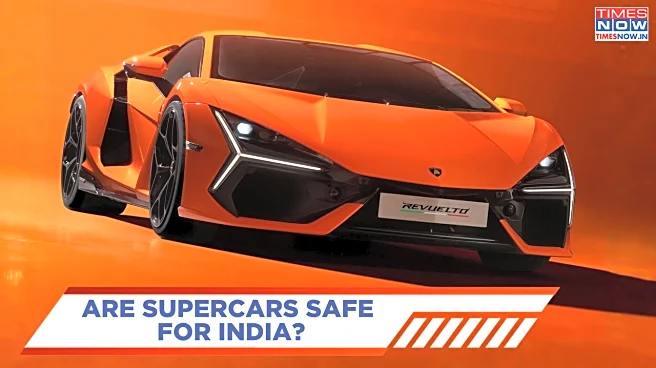
The recent crash of a Lamborghini Revuelto supercar in Kanpur, Uttar Pradesh, has again brought the debate of the safety of sports cars on Indian roads into the spotlight. With major tier 1 and tier 2 cities facing high traffic congestion daily, the argument against supercars states that these vehicles, which can catch triple-digit speeds within a few seconds, are not suitable for Indian traffic, which is highly unpredictable. However, is it the vehicle's fault or the driver's?
The Lamborghini Revuelto in question is the Italian automaker's flagship model, which was recently launched and costs approximately Rs 10 crore on-road, in India. It has a hybrid powertrain that, combined with a 6.5-litre, V12 engine, produces a whopping 1,000 hp of output.
To put the Revuelto's capability in perspective, it can go from 0-100 kmph in just 2.5 seconds. In comparison, a mass-market performance sedan such as the Volkswagen Virtus GT can do the same in approximately 10 seconds. This makes the Revuelto look like a potential missile if not driven carefully.
Just like any other vehicle, the Lamborghini Revuelto offers all standard safety features expected in a modern car to ensure the safety of the occupants and pedestrians around it. These include 5 airbags, ABS, Electronic Stability Control and more to keep both car and driver in check. It also comes with carbon ceramic brakes with massive 410mm discs on the front and 390mm discs at the rear, to ensure it has effective stopping power. A major highlight in the Revuelto's safety arsenal, is its carbon fibre 'Monofuselage' chassis. Last but not least, the Revuelto also takes a step further with ADAS (autonomous) safety features to increase its safety. Functions such as active lane departure warning come as standard in the Revuelto.
Apart from the safety and technology, there is also the circumstance factor that needs to be considered in such a case. It is common knowledge that driving a performance-oriented supercar in India requires patience, as they have minimal ground clearance and need to be carefully maneuvered over large speed breakers and rough patches that are common across Indian roads. Considering both engineering and circumstantial factors, it can be said that such accidents by sophisticated vehicles like the Revuelto do not highlight supercars as risky machines for India. Instead, it brings the carelessness of the driver into question. The same applies to all car drivers, be it an economy hatchback or a luxury SUV. When drivers ignore traffic rules against dangerous driving and speeding, they pose an immediate risk to other vehicles and pedestrians present on public roads.
A supercar's limits should only be explored on a race track or closed circuit, on public roads, it needs to obey traffic laws like all other vehicles. Considering some countries prohibit drivers from purchasing high-performance machines without obtaining proper training and a special license, it might be time for Indian traffic authorities to do the same.
/images/ppid_a911dc6a-image-177063642375377933.webp)

/images/ppid_a911dc6a-image-177063614887391562.webp)
/images/ppid_a911dc6a-image-177063607691813949.webp)
/images/ppid_a911dc6a-image-177063603910732315.webp)
/images/ppid_a911dc6a-image-177063617985511206.webp)
/images/ppid_a911dc6a-image-177063611524442751.webp)