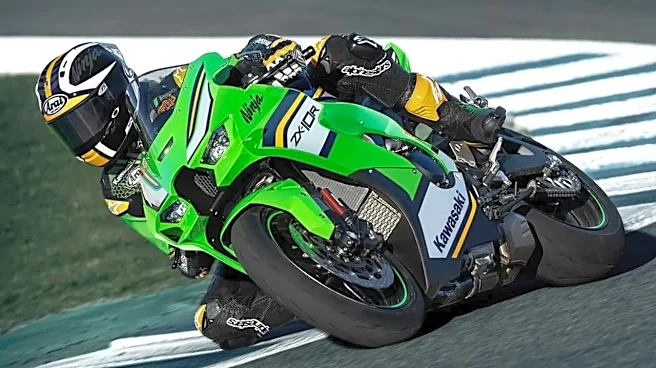




Kawasaki Ninja ZX-10R is currently priced in India at Rs 20.79 lakh (ex-showroom) and that number covers a 998cc superbike built around technology borrowed straight from Kawasaki's World Superbike program. If you're trying to figure out whether that price is justified before booking a test ride, it helps to break down exactly what's bundled in: the engine, the electronics as well as the hardware that separates a track-focused superbike from anything else in a showroom.
What Engine and Power Figures Do You Get?
At the core of the Ninja ZX-10R sits a 998cc, liquid-cooled inline-four that puts out 193 hp at 13,000 rpm, rising to 202 hp when the RAM Air intake kicks in at speed. Torque peaks at 112 Nm at 11,400 rpm, sent through a 6-speed gearbox with a wet multi-disc clutch and chain final
drive. It's a high-revving, naturally aspirated unit instead of anything turbocharged or hybridised which is fairly standard for this class of literbike but worth knowing if you're coming from a smaller-displacement machine and expect the power to land lower in the rev range.
What Electronics and Braking Hardware Are Included?
This is where the price tag starts making more sense. The Ninja ZX-10R comes with Kawasaki's Cornering Management Function, predictive traction control (S-KTRC), launch control, a quickshifter, adjustable engine braking along with electronic cruise control, all run through an IMU that tracks the bike's orientation in real time.
Braking duty goes to dual Brembo M50 monobloc calipers up front and suspension is handled by Kawasaki's Balance Free front fork and rear shock, both developed alongside the brand's WSB race team. A 5-inch TFT dash with smartphone connectivity rounds off the package, though it's worth noting India gets front-only ABS rather than a linked front-rear system.
How Does the Weight and Size Stack Up?
The Kawasaki Ninja ZX-10R weighs in at 207 kg kerb, rides on a 1,450mm wheelbase and offers 135mm of ground clearance. These figures are roughly in line with rival litre bikes from this segment. Seat height comes in at 835mm, tall enough that shorter riders should sit on one before committing. With a 17-litre fuel tank and a riding position built for circuit use rather than commuting, this remains a bike best suited to riders who plan to actually use its track-bred electronics and not just its badge.